If you're evaluating procure-to-pay software, you're probably already past the point of debating whether you need it. The real challenge now is figuring out which platform actually fits your organization.
That decision isn’t always straightforward. Procure-to-pay solutions vary widely in what they focus on. Some emphasize procurement automation, others combine purchasing with expenses or payments, and some are designed for complex sourcing and supplier management.
Choosing the wrong platform can create just as much friction as the manual processes you're trying to replace.
This guide compares 5 widely evaluated procure-to-pay platforms—Fraxion, Precoro, Procurify, Tradogram, and Bellwether—and explains where each tends to fit best so you can narrow your shortlist quickly.
Quick decision guide: which procure-to-pay platform might fit your organization
The following overview can help you quickly identify which platforms are worth exploring further:
-
If your goal is to bring structure and visibility to purchasing across departments—with clear approval workflows, real-time budget validation, and clean ERP integration—platforms like Fraxion are typically designed for that environment. This approach works particularly well for mid-sized organizations where finance needs stronger oversight of purchasing without introducing the complexity of enterprise procurement suites.
-
If your immediate priority is simply replacing spreadsheets and email-based purchasing with a lightweight procurement workflow that can be implemented quickly, Precoro may be worth considering.
-
If your organization prefers managing spending primarily through corporate cards and payments, with procurement workflows supporting that model, Procurify may align with that approach.
-
If supplier sourcing, vendor collaboration, and supplier performance management are central to your procurement strategy, Tradogram may provide tools that extend further into those areas.
-
If your organization needs purchasing automation combined with inventory management, Bellwether may be a better fit, particularly for businesses managing physical goods and stock levels.
Although all of these tools fall under the procure-to-pay category, they are built to solve different operational problems—which is why understanding your purchasing workflows is often the fastest way to narrow the field.
Software comparison: top 5 procure-to-pay solutions in 2026
| Solution |
Best for |
Key differentiators |
P2P features |
Potential drawbacks |
|
Fraxion
|
Mid-sized organizations needing strong purchasing control and spend visibility |
AI-driven spend analytics, strong mobile experience, flexible ERP integrations
|
Requisition-to-PO, custom approvals, budget and policy compliance, receiving, AI AP automation, invoice matching and approvals, travel and expense management, cash advances, spend analytics and custom reporting, mobile app, Catalog, PunchOut, PunchIn, MS Teams and ERP integrations |
Can be too comprehensive for small companies with basic needs, no contract management or supplier portal |
|
Precoro
|
Small to midsize companies that need to centralize core procurement functions |
Fast deployment
Customizable intake-to-procure tool
|
Purchase requests, approvals, POs, vendor management, AP automation, expense management, PunchOut, PunchIn, analytics and reporting, mobile app, accounting integrations |
Lacks native ERP integrations, crowded user interface, feature and mobile app limitations |
|
Procurify
|
Mid-large companies looking for a customizable solution for requisition to payment processes |
Pre-funded physical and virtual spending cards
Payments
|
Requisition-to-PO, approval routing, budget tracking, mobile app, AI AP automation, invoice matching, payments, expense management and spending cards, PunchOut, Slack and ERP integrations |
Limited integration functionality and depth. Does not support legacy ERP integrations |
|
Tradogram
|
Small to midsize companies needing a customizable solution with supplier and e-sourcing tools |
E-sourcing and supplier collaboration |
Requisition-to-PO, approval, receiving, invoice processing, invoice matching and approvals, reporting,
e-sourcing, supplier performance, contracts, expenses, inventory, integrations, mobile app, items catalog
|
Limited AP automation functionality and mobile app capabilities, not SOC 2 compliant
|
|
Bellwether
|
Small to medium-sized companies needing purchasing automation and inventory management |
Modular, à la carte feature structure |
Requisition-to-PO, RFQs,2 and 3 -way matching, AP automation, inventory and asset management, integrations |
No native mobile app, no expense management, outdated user interface |
1. Fraxion — best for mid-market organizations needing structured purchasing and strong spend visibility
Product overview
f your organization needs stronger structure around purchasing decisions while still keeping the ERP as the financial system of record, Fraxion is often evaluated as a mid-market procure-to-pay solution designed for that environment.
The SOC 2 compliant platform connects purchasing requests, approval workflows, budget tracking, and accounts payable automation into a single workflow. Instead of managing those steps across spreadsheets, emails, and accounting systems, Fraxion structures the process so finance teams can see and control spending decisions earlier.
Industries where financial oversight and accountability are particularly important—such as education, agriculture, biotechnology, and nonprofits organizations—frequently adopt this type of approach.
What sets Fraxion apart
Fraxion makes it easy to manage procurement (whether or not you have a dedicated procurement team, or if it's managed by finance), by establishing the internal controls and policies needed to ensure compliance. In addition to offering a full procure-to-pay suite, the platform also provides:
Fraxion Insights features embedded AI analytics with custom reporting, visual dashboards and key performance indicators (KPIs). It offers clear visibility into spending patterns, helps you identify process inefficiencies and cost-saving opportunities, and enables benchmarking through community insights.
Robust mobile experience
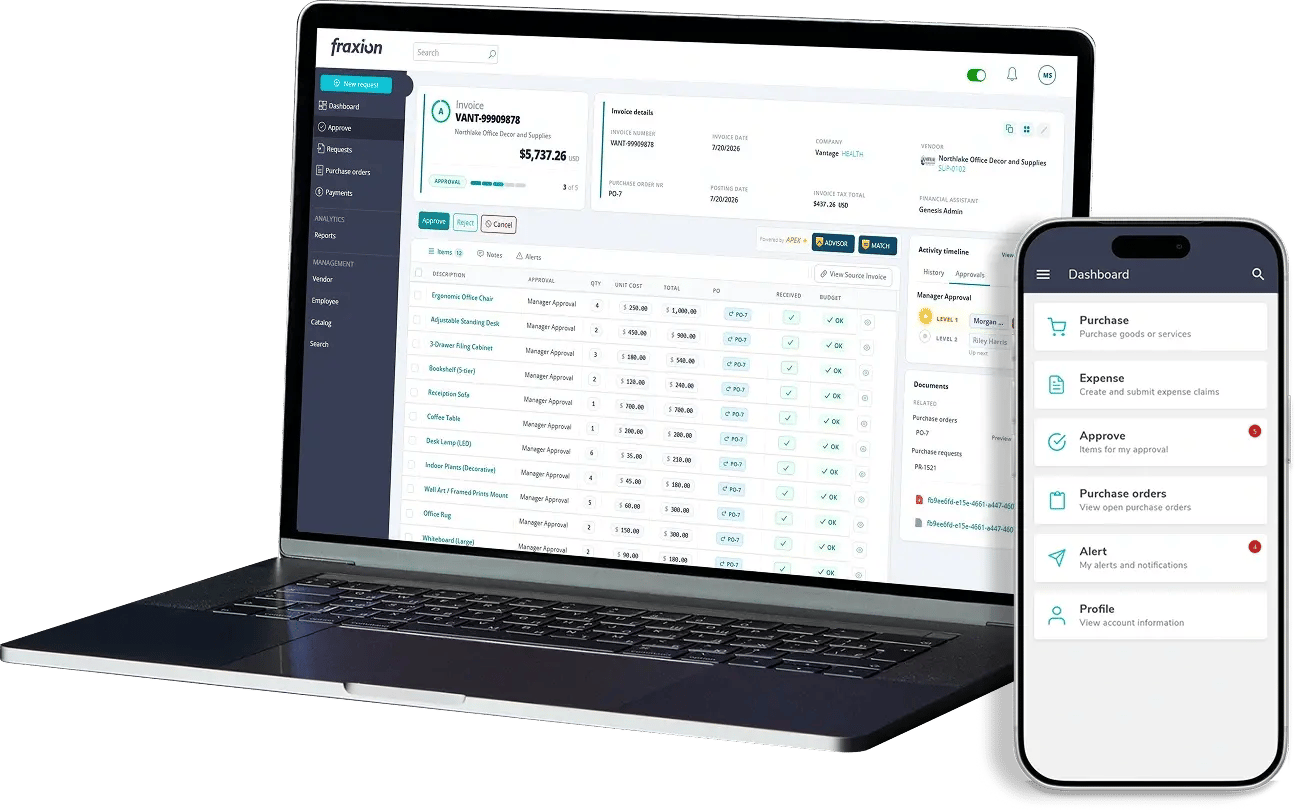
Fraxion’s mobile app offers advanced functionality, allowing you to effectively manage requests, budget reviews, approvals, and purchase orders. You can receive goods and services, and handle invoice approvals on-the-go, anytime, anywhere.
Flexible integrations
Fraxion integrates with cloud, legacy, and niche accounting and ERP systems. It also supports over 50 PunchOut vendor catalog integrations. Its advanced Microsoft Teams integration goes beyond just notifications. You can manage requisitions, budget reviews, and approvals directly within Teams.
Keep in mind
Fraxion is generally a better fit for mid-sized organizations with established purchasing processes. Very small companies with minimal procurement structure may find the platform more comprehensive than they need.
The platform currently does not include full contract lifecycle management or a dedicated supplier portal.
What customers are saying
"It used to take me a month and a half just to enter invoices; now I can easily get through each one in about three to four minutes. Fraxion pulls in all the details—prices, quantities—so it’s much easier to spot mistakes. It’s made my job so much easier."
“With Fraxion, we now have far greater visibility into our spending—a level we never had before. Our management team can see exactly who our top spenders are, what they're buying, and how costs are allocated, it’s really changed the way we operate.”
Elizabeth Sanchez, Purchasing & Inventory Manager at Monson Fruit Company
“One of the primary advantages of Fraxion is its ability to provide visibility into every transaction. This transparency allows us to seek out the best deals for high-dollar purchases, often leading to savings. For example, we saved $3,000 on a $15,000 machine purchase by leveraging the system’s integrated vendor programs. We frequently see cost reductions—sometimes up to 20%”
Rob Seymour, Purchasing Manager at The Hotchkiss School
Need better spend visibility and control? See how Fraxion brings it all into a centralized solution. Get in touch.
2. Precoro — strong for smaller teams transitioning from manual procurement
Product overview
If your primary goal is replacing spreadsheet-based purchasing with a structured digital workflow, Precoro is often considered a practical starting point.
The platform focuses on centralizing the core procurement process—purchase requests, approvals, purchase orders, and vendor management—in a system that is relatively easy for teams to adopt.
Organizations transitioning away from manual procurement processes often find this approach appealing.
What sets Precoro apart
Precoro is a solid choice for companies tired of slow, manual processes. It covers the basics well and helps you stay on top of budgets without adding more workload. You get automation, budget control, and collaboration all in a single platform.
Fast onboarding: Teams can be up and running quickly. The customer success team offers hands-on support to make setup smooth and tension-free.
Intake-to-procure simplicity: Their intake management tool makes it easy for team members to submit requests, collaborate, and approve in a well-organized structure.
Customizable setup: Precoro offers flexibility in configuring workflows, user roles, and approval paths to fit how your organization actually operates.
Keep in mind
While Precoro integrates with many accounting systems, it lacks native integrations with some ERP platforms. For organizations with complex ERP environments, this can create limitations.
Some users also report that the interface can feel crowded when managing larger purchasing volumes.
3. Procurify — good fit for organizations prioritizing card-based spending and payments
Product overview
If your organization prefers combining procurement workflows with corporate card spending and payment capabilities, Procurify is often evaluated as a hybrid solution. The platform supports traditional procurement workflows while also allowing organizations to issue virtual or physical spending cards with predefined limits.
This approach allows finance teams to monitor both purchasing requests and employee spending within a single environment.
What sets Procurify apart
Procurify offers tools to streamline spending, from expense tracking and categorization to efficient payment processing.
Expense card controls: You can issue virtual or physical spending cards, set pre-approved limits, and track expenses in real time. The platform also lets you snap photos of receipts and submit expenses instantly.
Customized organizational categories: The platform includes a feature for customized organizational categories, enabling organizations to define primary and secondary categories that reflect their specific operational units. This supports more accurate tracking and reporting across different segments of the organization.
Payment efficiency: Payments can be approved, processed, scheduled, and deposited directly through the platform.
Keep in mind
Although Procurify integrates with several accounting systems, the depth of these integrations can vary. The platform also focuses primarily on cloud-based financial systems and does not support many legacy ERP environments.
4. Tradogram — suited for companies focused on sourcing and supplier collaboration
Product overview
If supplier sourcing and vendor management play a major role in your procurement process, Tradogram may offer capabilities that extend beyond basic purchasing automation.
The platform combines procurement workflows with tools designed to manage supplier relationships, track vendor performance, and support sourcing decisions.
Organizations that regularly evaluate vendors or conduct sourcing initiatives often prioritize these capabilities.
What sets Tradogram apart
Tradogram is a good choice for businesses looking to enhance their sourcing and supplier management processes.
Supplier performance management: Automatically organize supplier records, track performance, and evaluate compliance with Tradogram’s supplier management software. It helps you make better decisions when choosing or reviewing vendors.
Strategic sourcing tools: Tradogram includes a white-labeled sourcing platform with tools for forecasting total cost of ownership, comparing bids, and storing contracts. This gives you the context you need to negotiate confidently and collaborate with suppliers long-term.
Free plan available: Get access to basic tools like PO management, invoice matching, and receiving tracking. It includes one user and up to five transactions per month.
Keep in mind
Tradogram’s accounts payable automation capabilities are more limited than some other procure-to-pay platforms. Its mobile application also offers fewer capabilities than the desktop version.
Tradogram does not currently hold SOC 2 compliance. This can be a concern for businesses that prioritize stringent data security standards.
5. Bellwether — useful for teams needing procurement combined with inventory management
Product overview
If your organization manages purchasing and inventory closely together, Bellwether may be a relevant option to evaluate.
The platform combines procurement automation with inventory management tools, allowing businesses to track stock levels alongside purchasing activity.
Its modular design allows organizations to select specific capabilities depending on their operational needs.
What sets Bellwether apart
Bellwether’s modular setup and feature set offer flexibility for organizations that need to manage purchasing and inventory processes more effectively.
Customizable modular features: Bellwether’s modular design allows businesses to tailor the software to their specific needs.
Robust purchasing and inventory management: Streamlines processes, reduces errors, and ensures efficient stock control.
Integration capabilities: Improves functionality and data flow across systems by integrating with third-party platforms.
Keep in mind
Bellwether currently does not offer a native mobile application, which may limit accessibility for teams that rely on mobile approvals. Some users also report that the interface feels outdated compared with newer procurement platforms.
How to choose the right procure-to-pay platform for your organization in 2026
Choosing the right platform usually comes down to how purchasing actually happens inside your organization.
Start by examining how employees request purchases and how approvals are handled today. If purchasing decisions often happen informally, the system you choose should make structured requests simple and intuitive.
You should also consider how budgets are reviewed during approvals. Platforms that allow managers to see the budget impact before approving purchases can significantly reduce financial surprises later.
ERP integration is another important factor. Procure-to-pay systems typically work best when they complement the ERP rather than trying to replace it.
Finally, pay close attention to usability. If employees find the system difficult to use, purchasing decisions will likely move outside the platform.
Take full control of your procure-to-pay process and start saving with Fraxion
Selecting a procure-to-pay platform ultimately comes down to choosing a system that fits the way your organization manages purchasing decisions.
If you're evaluating platforms designed specifically for mid-market finance teams, solutions like Fraxion bring together structured purchasing workflows, spend analytics, mobile approvals, and flexible ERP integrations in a single environment.
Stop reacting to spend after it happens. Start making smarter spending decisions today.
Request a Fraxion demo and see how easy it can be to stay in full control of your procurement activities and operational spend.
Evaluating procure-to-pay software in 2026 FAQ:
1. How do I know which procure-to-pay platform is actually the right fit for my organization?
The biggest difference between P2P platforms usually isn’t the feature list—it’s the organization size the platform was designed for.
Some systems are built for large procurement teams managing complex sourcing and supplier networks, while others focus on simple purchasing workflows for smaller companies. Many mid-market finance teams need a solution in between: a platform that structures purchasing, enforces approvals, provides spend visibility, and scales as the organization grows, all without the complexity of enterprise procurement suites.
Platforms like Fraxion are built for mid-sized companies, connecting purchasing and accounts payable with proactive spend controls, flexible integrations, and the scalability to grow with your organization.
2. What differences between procure-to-pay platforms matter the most?
The differences that matter most between procure-to-pay platforms are how effectively they structure workflows, enforce policy controls, and provide visibility throughout the spend cycle. Not all systems connect purchase requests, approvals, purchase orders, and invoices in a single workflow, or provide automation for approvals, budget checks, and policy enforcement.
Some platforms offer limited visibility into committed spend, weak audit trails, or minimal support for two- and three-way invoice matching. Choosing a platform that delivers these capabilities ensures finance can prevent overspending, reduce errors, and maintain compliance, rather than simply documenting transactions after the fact.
3. How can finance teams tell if a procure-to-pay system will actually be adopted internally?
Adoption usually comes down to one question: is submitting a purchase request easier than sending an email? If the workflow is complicated or slow, employees will bypass the system, and finance loses visibility and control over spending.
Platforms that simplify request submission, enable quick approvals, and support mobile access tend to see much stronger adoption across departments. This is why many mid-market teams prioritize usability, workflow simplicity, and real-time spend visibility when evaluating systems like Fraxion or Precoro.
4. What’s the biggest mistake companies make when choosing procure-to-pay software?
One of the most common mistakes is choosing a platform based on features instead of operational fit.
Some procurement systems are designed for enterprise sourcing teams and can be unnecessarily complex for mid-market organizations. Others are extremely lightweight and may not provide the level of financial oversight finance teams expect.
The most successful implementations usually happen when the platform matches the organization’s operational reality—how purchasing decisions are made, how budgets are managed, and how invoices are processed.
5. How can we tell if procure-to-pay software will improve visibility and control?
For many finance teams, the deciding factor becomes how clearly the platform structures and guides purchasing decisions before money is committed.
When purchase requests, approvals, budgets, purchase orders, and invoices are connected in a single workflow, finance teams gain real-time visibility into spending decisions, can evaluate and enforce policy compliance proactively, and accounts payable spends far less time resolving exceptions. Platforms designed with this workflow in mind, including systems like Fraxion, often stand out during vendor evaluations because they enable proactive control over spend by connecting every step into a single, auditable process.