As organizations grow, so too does the complexity of purchasing goods and services — particularly when it comes to maintaining compliance with budgets, policies, and internal controls. Manual procurement processes that rely on spreadsheets, emails, and disconnected systems often result in delayed approvals, limited visibility into spend, and overspending — challenges that finance teams must address to enable strategic decision-making and safeguard margins.
Procurement and procure-to-pay (P2P) software addresses these challenges by automating the entire procurement lifecycle. Automated solutions enhance efficiency, improve transparency, and strengthen compliance, while integrating with ERP and accounting platforms to centralize data and reduce manual errors.
Precoro is a widely recognized option in this space, offering requisition and PO management, approval workflows, and AP automation — making it a strong choice for growing teams. That said, financial leaders often evaluate alternative solutions to identify the best fit based on their organization’s size, budget, and operational maturity.
Below are five alternatives — ranging from streamlined purchasing tools to full-featured procure-to-pay suites — highlighting their strengths, considerations, and key differentiators, informed by user reviews and product overviews.
Decision guide: which Precoro alternative is best for your business needs?
|
Platform
|
Best for
|
Integrations
|
Considerations
|
| Fraxion |
Mid-size companies needing P2P, spend management, analytics and mobile-enabled workflows.
|
Sage solutions, Microsoft Dynamics solutions, QuickBooks, Xero, NetSuite
Messaging app: Microsoft Teams
50+ PunchOut catalogs
PunchIn
|
No inventory capabilities or self-service supplier portal
|
| ProcurementExpress.com |
Small to mid-size companies needing procurement essentials and fast implementation.
|
Native QuickBooks
Via Zapier: NetSuite and Xero
Messaging app: No native integrations
PunchOut
|
Limited spend analytics with basic AP automation capabilities
|
| Tradogram |
Smaller teams needing essential purchasing with supplier management and collaboration needs.
|
QuickBooks, Xero, NetSuite, Microsoft Dynamics, Sage, SAP, Oracle
20+ PunchOut catalogs
|
Basic P2P and inventory and lacks deep analytics and advanced automation
|
| Order.co |
Teams needing AI‑driven sourcing and consolidated billing.
|
QuickBooks, Xero, NetSuite, Sage, Workday (via partners)
Messaging app: No native integrations
PunchOut
|
No native mobile app, supplier portal or expense workflows
|
| ProcureDesk |
For small to mid-size companies with growing P2P needs.
|
QuickBooks, NetSuite, Xero, Sage Intacct, Dynamics 365, Bill.com
Messaging app: Slack (in some plans)
200+ PunchOut catalogs
|
Limited direct ERP integrations, basic spend analytics and mobile functionality
|
|
Precoro
|
Small to mid‑sized teams needing centralized P2P and control across spend categories.
|
NetSuite, QuickBooks, Xero, Sage, Microsoft Dynamics solutions, Odoo.
Messaging app: Slack
11 PunchOut catalogs
PunchIn
|
Basic spend analysis and limited mobile functionality and inventory capabilities
|
1. Fraxion
Who is it for
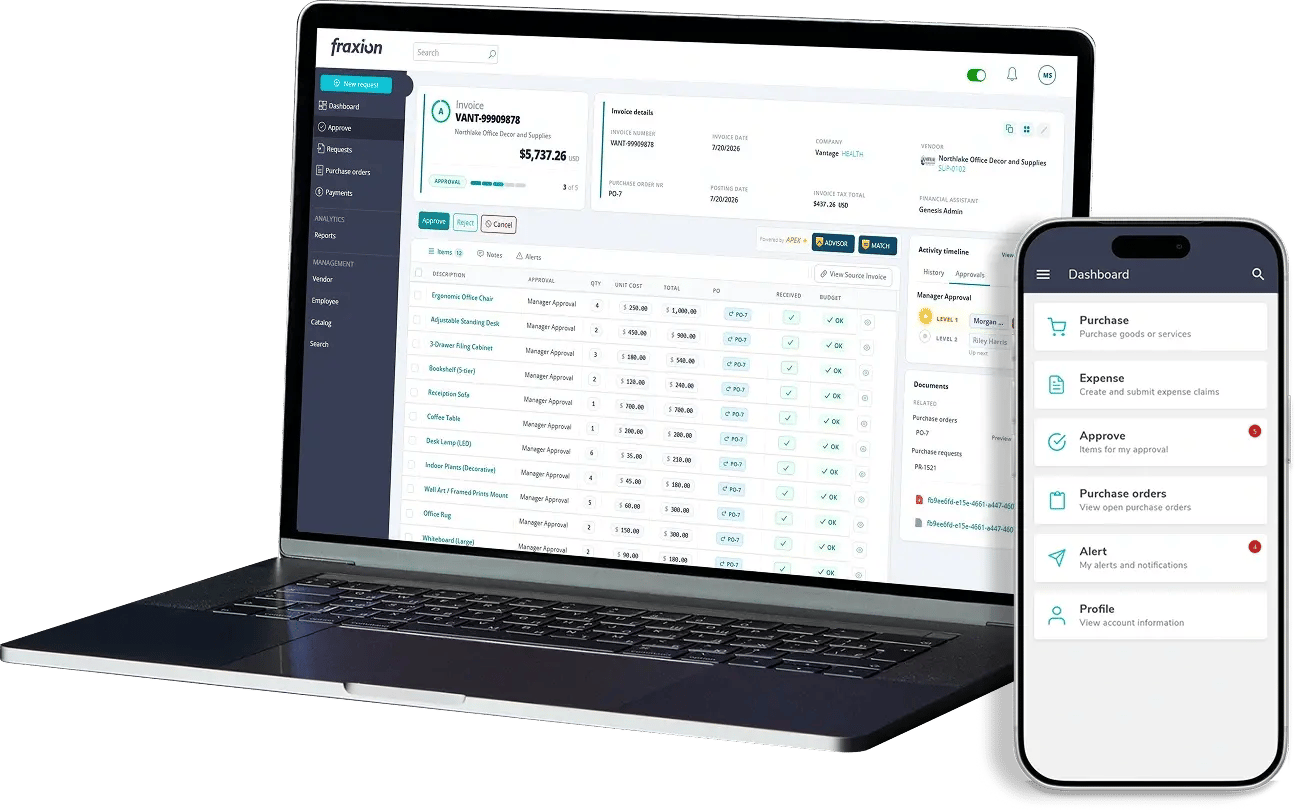
Fraxion is designed for mid-size organizations that need one complete solution for procure-to-pay and proactive spend management. It offers an all-in-one platform that scales based on your needs for purchase expense, and accounts payable automation, with advanced spend analytics and reporting - eliminating the need for additional tools. Fraxion integrates seamlessly with cloud, niche, and legacy ERP and accounting systems and is mobile-supported, so processes keep moving, wherever work happens. The platform is backed by robust policy controls, real-time budget visibility, and ensures that organizations are always audit-ready.
Stand-out features
- Comprehensive P2P automation: Fraxion manages the entire procure-to-pay lifecycle, from purchase requests and multi-level approvals to AI-powered invoice capture and accounts payable automation, helping organizations reduce errors, accelerate processing, maintain compliance, and spend control.
- Advanced spend analytics and reporting: The platform provides community insights and benchmarking, KPI dashboards, actionable recommendations for process improvement, and custom report creation, giving finance teams a deep understanding of spending patterns and areas for optimization and savings.
- Feature-rich mobile app: A strong mobile experience, enabling users to submit and approve purchase and expense requests, review budget impacts, receive items, view POs, and approve invoices.
- Microsoft Teams integration: For Microsoft first companies, Fraxion connects seamlessly with Teams to enable fast, familiar processes for purchase requests, budget reviews, and approvals, allowing teams to work within the collaboration tool they already use.
Industries where Fraxion excels
Agriculture, Wineries, Healthcare and Life Sciences.
→ Read industry case studies here.
Considerations
Fraxion does not offer dedicated inventory management, self‑service supplier portals, or advanced contract lifecycle management built into the base platform — features some organizations would value for more complex procurement ecosystems.
Users frequently describe Fraxion as easy to use and effective at enforcing organizational policies and praise its integration with ERP systems and note the support team is highly responsive during implementation and day‑to‑day usage. While other users on Get App report that supplier interaction and management is limited.
→ Check out our full comparison blog on Fraxion vs Precoro
2. ProcurementExpress.com
Who is it for
ProcurementExpress.com is best for small to mid-sized organizations seeking an easy-to-use procurement solution focused on the essentials. Teams with straightforward purchasing needs and limited IT resources benefit most from its fast deployment and minimal learning curve.
Stand-out features
- Fast and intuitive PO workflows: Designed for simplicity, allowing teams to create and approve purchase orders quickly with minimal training.
- Live budget tracking and spend alerts: Departmental budgets update instantly as requests are raised and approved, helping prevent overspending.
- Strong mobile approval experience: Managers can review and approve requests from anywhere, making it ideal for field-based or distributed teams.
Industries where it performs best
Construction, Retail, Hospitality, and Small service-based businesses.
Considerations
ProcurementExpress.com lacks advanced spend analytics and reporting, AP automation capabilities are basic, and there are no inventory or expense reporting modules. GetApp reviews highlight the platform’s ease of use and mobile accessibility but also mention limitations in supplier performance tracking, and reporting detail.
3. Tradogram
Who is it for
Tradogram is designed for small to mid-market teams and organizations that need a straightforward cloud-based procurement solution with essential PO control, supplier management and collaboration — without the complexity of full procure-to-pay suites.
Stand-out features
- Simple purchase order and requisition management: Helps teams create, track, and manage POs efficiently with multi-level approvals and configurable templates.
- Supplier and vendor management: Centralized supplier records and basic performance tracking support vendor engagement and oversight.
- Integrated supplier collaboration features, including instant messaging, shared discussion threads, and document exchange, enabling procurement teams and vendors to coordinate directly on purchase orders, RFQs/RFPs, and related documents.
Industries where it performs best
Construction, Wholesale/Distribution, and Education.
Considerations
Spend analytics and insights are limited compared with other P2P solutions, so advanced spend intelligence may require external reporting. Inventory functionality is also basic and lacks depth.
Reviewers on Capterra noted that Tradogram is “very user friendly and helps approve purchase requests easily,” while some users pointed out issues with inventory usability and vendor email delivery.
4. Order.co
Who is it for
Order.co is an AI-powered procurement and spend management platform designed for mid-sized businesses and growing companies that want to centralize purchasing and spending processes. It helps teams efficiently source cost-effective suppliers, automate workflows, and manage payments — including virtual cards while maintaining strong finance control.
Stand-out features
- AI-assisted supplier sourcing and cost control: Uses AI to identify the most cost-efficient suppliers and pricing options, helping organizations reduce procurement expenses.
- Unified purchasing workflow: Brings together purchase requests, approvals, purchase orders, and order tracking in one platform, removing the need for multiple disconnected systems.
- Adaptable payments and virtual card management: Provides support for virtual cards and flexible payment methods, giving finance teams greater oversight of cash flow and vendor transactions.
Industries where it performs best
Retail and Hospitality
Considerations
Approval workflows are less flexible than in high-end P2P solutions, which can constrain complex purchasing controls. The platform is not supported by a native mobile app, only mobile access to the system.
While some users note that reporting and spend analytics are limited and ERP / accounting integration often requires extra configuration, others highlight on Gartner that Order.co effectively consolidates orders from multiple vendors into a single, easy-to-use dashboard.
5. ProcureDesk
Who is it for
ProcureDesk is a cloud‑based procure‑to‑pay solution designed for small to mid‑market organizations that need stronger purchasing controls, budget oversight, and automated accounts payable workflows without the complexity or cost of enterprise procurement suites. It’s particularly well‑suited to finance and operations teams that want to streamline requisitions, approvals, purchase orders and invoice processing in one centralized system.
Stand-out features
- Comprehensive procure‑to‑pay workflow: Supports the full lifecycle from purchase requests and approval routing through automated PO creation, goods receipt tracking, and invoice matching — reducing manual effort and errors.
- Real‑time budget controls: Displays up‑to‑date budget information at the point of purchase request, which helps prevent overspending and aligns spending with financial plans.
- Large PunchOut catalog library: Includes access to 200+ vendor punchout catalogs, enabling buyers to shop approved supplier catalogs without manual data entry.
Industries where it performs best
Manufacturing and Professional Services
Considerations
ProcureDesk offers solid P2P functionality, but spend analytics capabilities are limited compared to other platforms, which may constrain deeper spend insights or reporting. The mobile experience is functional for approvals but doesn’t replicate all desktop features, so complex workflows may still require a desktop. Additionally, while ProcureDesk integrates with common accounting systems like QuickBooks and Xero, organizations with highly customized or legacy ERP systems may need extra configuration to ensure smooth data syncing.
A few users mention on Capterra that the mobile app, while functional for approvals, doesn’t mirror every desktop feature, which can be a limitation for mobile‑centric teams.
Finding the right procurement system for your business today — and tomorrow
Choosing the right procurement solution is about more than comparing feature lists — it’s about understanding your organization’s current needs and how those needs will evolve as your business grows.
Start with a clear assessment of your most pressing priorities: Do you need strong policy controls? Deep accounts payable automation? Spend analytics or strategic sourcing? How important are mobile processes or integration with existing ERP/accounting systems?
Beyond internal assessment, make use of independent third‑party review sites such as Capterra, G2, GetApp, and Gartner Peer Insights to gather unbiased insights from real users who have similar challenges. These platforms highlight both strengths and common limitations that may not be obvious on vendor marketing pages.
Viewing product demos allows you to see how a solution behaves in your specific industry context and whether its workflows will be effective in your operational reality. Involving cross‑functional stakeholders in the evaluation ensures alignment and helps avoid costly missteps later.
Procurement tools should not only solve today’s issues but also scale with you. Look for platforms with flexible configuration, strong support for integrations, and a clear roadmap for enhancements. Balancing short‑term needs with long‑term vision will help you select a system that supports both efficient execution and strategic decision‑making.
Why Fraxion is a strong Precoro alternative for mid-sized businesses
Among the solutions reviewed, Fraxion is a strong choice for finance teams seeking a robust, scalable solution. Start with procurement, and grow into full procure to pay with ease.
While no solution is perfect for every organization, Fraxion’s balanced mix of procurement, expense, AP capabilities, advanced analytics and reporting, and flexible workflow configuration makes it especially suitable for mid‑market businesses and organizations looking to centralize financial controls without layering on multiple point tools. It delivers both the operational efficiency finance teams need today and the visibility and compliance foundations that support growth and complexity tomorrow.
Book a personalized demo to see how Fraxion can reduce maverick spending, simplify audits, and ensure every purchase aligns with your policies.
FAQs choosing the best Precoro alternative:
1. What should finance leaders look for in a Precoro alternative?
Finance and AP leaders should look beyond basic requisitions and PO creation. The right solution should:
- Enable budget impact review before spend is approved
- Support complex, multi-level approval workflows
- Manage policies with internal controls
- Integrate seamlessly with your ERP or accounting system
- Provide real-time visibility, spend analysis, and audit-ready records
- Support native mobile workflows that keep processes and spend management moving seamlessly, wherever work happens.
- Scale with your organization: A platform that supports growing teams needs today, more complex workflows, and evolving requirements tomorrow.
For mid-sized organizations processing high transaction volumes across departments or locations, the difference between reactive reporting and proactive spend control is critical. The right platform should help you prevent overspending, not just report on it after the fact.
2. How do Precoro alternatives differ in terms of spend control?
Many procurement tools focus on request and approval workflows. Fewer provide real-time spend tracking across multiple budgets, funds, grants, and projects.
Procure-to-pay platforms like Fraxion are designed for proactive spend management. That means:
- Budget visibility and impact review before approvals happen
- Policy enforcement embedded into workflows
- Escalating multi-approval workflows and delegation of authority
- Multi-fund, multi-entity spend tracking and reporting
This level of control is especially important for organizations managing grants, funds, projects, or multiple entities where overspending creates compliance, audit, and funding risk.
3. Which Precoro alternative is best for mid-sized organizations?
Mid-market organizations (typically 50–500 employees) often outgrow lightweight purchasing tools but don’t need the cost or complexity of enterprise suites.
The best alternative for this segment should:
- Offer full procure-to-pay functionality (not just purchasing)
- Support ERP integrations with systems like Microsoft Dynamics, Sage, NetSuite, QuickBooks, or Xero
- Provide embedded spend analytics and reporting
- Handle multi-location, entity, and decentralized procurement processes
Fraxion is purpose-built for mid-sized companies that have outgrown manual processes and need spend visibility and proactive controls and transaction volumes grow.
4. How important are ERP integrations when evaluating procurement software?
ERP/ accounting system integration is one of the most critical evaluation criteria for finance leaders. The best procurement solutions support both legacy and modern cloud ERP systems, ensuring seamless data flow today while allowing your organization to scale to the cloud in the future. Robust integrations help maintain accurate GL coding, real-time spend visibility, and efficient workflows, regardless of your current technology stack.
Without a robust integration, teams face:
- Data silos and duplicate data entry
- Reconciliation errors
- Delayed financial visibility: Without real-time syncing, leaders may lack accurate insights into spend, budgets, and cash flow.
- Compliance and audit risks: Fragmented data makes it harder to enforce policies, track approvals, and prepare for audits.
The strongest Precoro alternatives provide native, bi-directional integration with ERP and accounting systems. This ensures that purchase orders, invoices, and approvals flow automatically into the general ledger with accurate coding, providing real-time visibility into spend while reducing manual effort and errors. Native integration also simplifies deployment and ongoing maintenance, eliminating the need for complex middleware or workarounds, and enabling finance teams to focus on strategic decision-making rather than reconciliation.
5. What makes Fraxion a strong Precoro alternative?
Fraxion is designed for mid-sized organizations that need more than lightweight purchasing, but without enterprise software complexity.
It's an all-in-one solution for purchasing, expense, and accounts payable automation and spend analysis.
- AI-powered procure-to-pay automation
- Real-time budget visibility
- Multi-level approval workflows
- Embedded spend analytics and reporting
- PunchOut integrations and internal Catalog hosting
- Flexible ERP integrations
- Strong mobile experience and Microsoft Teams-enabled processes
- Strong policy enforcement and audit-ready controls
For organizations that need structured, scalable, and proactive spend management, Fraxion offers a balanced combination of usability, control, and financial visibility.
.svg)