As a business grows, larger budgets and more tools are required, and operations can become widespread. This expansion can also multiply transactions, approval chains, and exceptions faster than the processes in place can handle them.
To restore clarity and control, the finance leader’s first instinct is to turn to ERP platforms. But ERP software is built to record transactions after they happen, not to prevent out-of-policy purchases from being approved.
What’s needed is a system that enables visibility and applies control before money leaves the budget, validating requests, enforcing policies, and syncing with ERP systems in real time. That’s exactly the role modern purchase order (PO) software plays—and where procure-to-pay solutions like Fraxion go further, uniting requisition-to-PO, spend and budget control, accounts payable automation, and ERP integration flexibility in one easy-to-use solution.
How to spot PO software you won’t outgrow
If your organization’s growing, your PO system has to keep pace with complexity, not create it. Here’s what to look for:
Live budget checks at the point of request
Every purchase should be within budget before it’s approved. Look for pre-commit validation tied directly to the GL, department or fund, not only post-spend reporting.
Seamless approvals in the platforms your staff already use
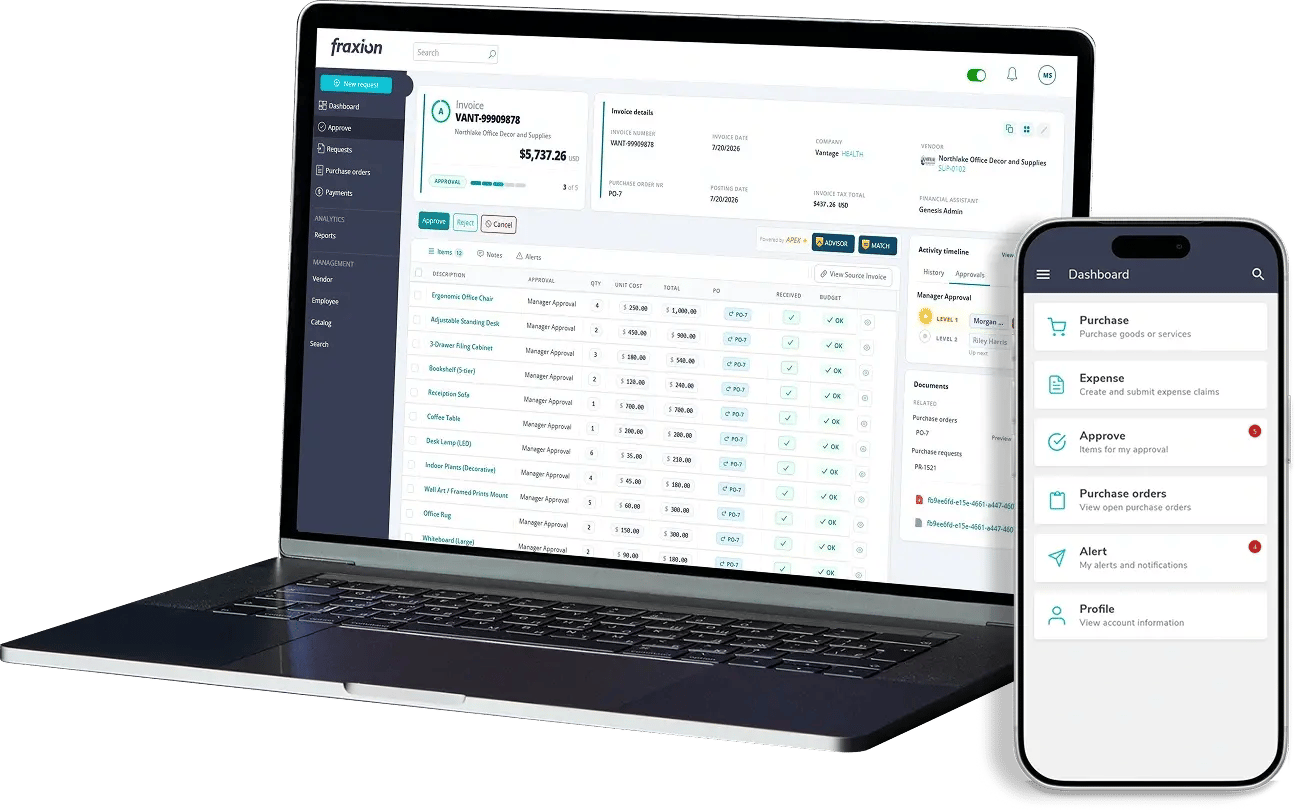
Employees won’t adopt a process that slows them down. Choose a PO system that routes requests and approvals through easy and familiar tools like a mobile app or Microsoft Teams integration, so policy enforcement happens anywhere and without extra clicks.
Flexible workflows that scale with structure
Scaling your organization doesn’t have to complicate approvals. Flexible workflows grow with your teams, adapting to keep processes consistent and efficient as departments, projects, or entities expand.
Easy, compliant purchasing with approved vendors
Channel all purchases through integrated vendor PunchOut catalogs or host internal catalogs—so staff access pre-negotiated contracts and business-only pricing, while every request follows easy, policy-compliant workflows with built-in budget checks.
Instant PO automation
Look for a PO system that turns approved requests into purchase orders automatically and can email vendors without extra steps. Everything is digital and auditable, giving you fast, compliant processes and complete records.
Effortless matching and auditability
Keep every record in one place—POs, receipts, and invoices, so matching happens with ease. Electronic three-way matching eliminates hours of manual effort across dispersed teams and multiple offices by automatically linking every invoice to its approved request, PO, and goods received note. This keeps your records consistently audit-ready, reduces the risk of overpayment, and frees your team from low-value reconciliation work. Consider a system with AP automation so you can easily manage requisitions right through to invoice approval, as your transactions grow.
Reporting that tracks decisions, not just dollars
Your system should provide a complete audit trail, showing where spend originated, who approved it, the budget it's linked to, and include date and time stamps.
Additionally, with embedded spend analytics and reporting you can analyze vendor, employee, and budget-level spending to uncover savings opportunities and maintain tighter control over every dollar.
When those mechanisms work together, finance stops policing and starts managing and optimizing. That’s what modern PO software should deliver: scalable structure—your team enjoys simplified, intuitive processes, while finance gains full visibility, tighter control, and actionable insights to optimize spend.
ERP synchronization that keeps data aligned
Budgets, suppliers, and accounts should match in both systems without manual updates. Look for PO software that keeps purchasing and accounting connected.
5 Signs your ERP and PO system are truly in sync
By now, you know what good PO software should do. Connecting it to your ERP or accounting system is what truly maximizes efficiency and accuracy. ERP integration keeps data aligned automatically, minimizes errors, and ensures every transaction flows seamlessly from purchase to ledger.
ERP integration should keep accounting and purchasing in lockstep. When you assess a software vendor, look for these indicators that your ERP and PO software actually work together:
- Live data connection: budgets, suppliers, and accounts update between systems automatically, so finance never manages two versions of the truth.
- Pre-commit validation: budget checks use the latest imported ERP data before any request is approved.
- Bi-directional visibility: transactions flow both ways. See approved commitments and budget status instantly without waiting for month-end reports.
- Resilient routing: workflows adapt based on the rules you define. When new departments or cost centers are added, the correct approval path is applied once those settings are configured—no need to rebuild entire workflows, you just update the relevant rules.
- Continuous audit trail: every request, approval, and payment can be traced from PO to invoice inside both systems, without reconciling separate reports.
When those conditions are met, integration becomes the foundation of lasting efficiency, accuracy, spend, and budget control.
Fraxion’s integration flexibility extends across cloud, legacy, and niche ERP systems, giving you accurate, synchronized data and a purchasing process that stays efficient, reliable, and scalable—no matter what system you’re running in the back office or plan to migrate to in the future.
.svg)
Top purchase order software alternatives to compare
When you start exploring PO software, you’ll find a range of tools that promise better visibility and control. The right choice depends on your organization’s size, feature requirements, and integration needs.
A few popular options in the market include Precoro, Procurify, Kissflow, and Coupa. Each brings different strengths in usability, reporting, or supplier management, but they vary widely in how deeply they integrate with your ERP and enforce budget control.
To see an in-depth comparison of leading PO systems, including features, pricing, and ideal use cases, explore Fraxion’s overview of the best purchase order software.
How Fraxion delivers spend control that scales
Fraxion gives finance the structure for transactions to grow without losing control. Every request, approval, and purchase follows built-in rules that apply policy where spending starts, not after reconciliation:
- Requests, budget checks, and approvals can happen via the web or mobile app, or directly in Microsoft Teams, where staff already work, so processes keep moving without delays or overspending.
- Internal controls drive policy compliance and log each action in digital audit trails.
- Staff can buy through PunchOut catalogs from approved vendors, keeping compliance effortless as teams expand.
- No purchase order can be generated without an approved request.
- Budgets and accounts stay synchronized with the ERP, giving finance real-time awareness of commitments and available funds.
That combination—flexible access and workflows, internal controls, policy enforcement, vendor management, and ERP integration—means processes can scale seamlessly as the organization grows.
Mukuru, a fast-growing fintech company, saw this firsthand. By automating approvals and linking requests to budgets, its finance team gained immediate visibility and control across a multi-national rollout and cut turnaround times dramatically. As volume increased, the same workflows simply expanded—no system rebuild, no extra headcount, no loss of control.
Fraxion is built for that kind of growth: it adapts as teams, structures, budgets, and reporting needs evolve, keeping procurement discipline consistent from one department to the next.
Book a demo and see how Fraxion delivers spend and budget control and ERP integration that scales with you.
FAQs
Why isn’t our ERP enough to manage purchase orders?
Your ERP isn’t enough to fully manage purchase orders because it primarily records spend after it occurs. While ERPs excel at accounting and reporting, many don't ensure budget and policy alignment, route approvals, or prevent overspending before commitment. Dedicated PO software like Fraxion fills that gap by applying policy and controls at the start and throughout the purchasing process.
What makes a PO system scalable as an organization grows?
A PO system is scalable when it easily adapts to added departments, cost centers, or entities. Flexible routing rules, synced budgets, and approval automation allow finance to keep control as transactions and complexity increases—exactly what Fraxion is built to handle.
How does ERP integration improve budget control?
ERP integration improves budget control by aligning accounting data with live purchasing activity. When budgets, suppliers, and accounts stay synchronized, finance sees commitments in real time. Fraxion connects directly with leading ERPs so data stays consistent without manual updates.
Will adding PO software slow down approvals or frustrate users?
Adding PO software shouldn’t slow anything down as it's designed with user experience in mind. Modern PO software like Fraxion routes requests through familiar tools—like mobile apps or Microsoft Teams—so approvals happen wherever staff are working from and within familiar tools. Instead of slowing people down, it simplifies and accelerates processes—no inbox chasing, no spreadsheet checks—so teams stay compliant and on budget while keeping work moving.