Manual purchase orders. Approval requests buried in email threads. Limited visibility into who is spending what across departments.
These are usually the signals that purchasing processes have outgrown spreadsheets and informal workflows. What may have started as a simple way to track vendor purchases often becomes difficult to manage as organizations grow and more employees begin initiating purchases.
At that point, many finance and operations teams begin evaluating purchase order software to bring structure to the process. The right PO platform centralizes requests, routes approvals automatically, and creates a clear record of purchasing decisions before orders are sent to suppliers.
The challenge is that not all purchase order systems solve the same problem. Some tools focus on basic PO creation for small teams, while others are part of larger enterprise procurement platforms designed for global supply chains.
To help you navigate the landscape, this guide compares five purchase order software platforms commonly evaluated in 2026: Fraxion, Coupa, Spendwise, Kissflow Procurement Cloud, and SAP Ariba.
How to evaluate purchase order software in 2026
Some purchase order platforms offer similar features on paper, but they are often designed for very different operational environments. The main differences usually come down to how purchasing requests enter the system, how approvals are managed, and how much visibility finance teams gain into spending.
Some tools focus primarily on digitizing purchase orders themselves. These platforms replace manual PO documents with a simple digital workflow and are often well suited for smaller teams that simply need a faster way to create and track purchase orders.
Other platforms focus on workflow customization, allowing organizations to design their own procurement processes and approval structures across departments.
At the other end of the spectrum are enterprise procurement suites designed for large organizations managing supplier networks, contracts, and complex global purchasing operations.
For many mid-sized organizations, however, the challenge is slightly different.
They need structured purchasing workflows that capture requests, enforce approvals, and provide clear visibility into spending without implementing a full enterprise procurement suite. Platforms like Fraxion are often evaluated in this environment because they connect purchase requests, approvals, and purchase orders with budget visibility and ERP integration.
Understanding where your organization fits along this spectrum makes it much easier to narrow down the right platform.
With that context in mind, let’s take a closer look at how these purchase order systems compare.
Side-by-side comparison: 5 best purchase order software in 2026
| Solution |
Best for |
Key differentiators |
Keep in mind |
|
Fraxion
|
Mid-sized companies seeking structured purchasing and spend visibility.
|
Complete P2P with embedded spend analytics and reporting.
Feature-rich mobile app.
Budget and policy control.
Integration flexibility. |
Not built for large enterprises and may offer more than small teams need. |
|
Coupa
|
Large enterprises with with complex global procurement operations. |
Enterprise-grade automation.
Deep AI analytics.
Integrated PO and inventory management. |
Enterprise pricing, lengthy implementation, and training required. |
| Spendwise |
Small teams replacing spreadsheets. |
Simple UX, quick setup, and budget-friendly. |
Limited scalability, basic reporting, limited native integrations. |
| Kissflow Procurement Cloud |
Organizations needing custom workflows. |
No-code workflow builder, modular setup, and customizable. |
Setup can be lengthy, lacks advanced features, and limited integrations.
|
| SAP Ariba |
Large organizations managing supplier collaboration. |
SAP Ariba Network, contract-linked POs, strong ERP ties. |
Steep learning curve and enterprise-level pricing. |

1. Fraxion - best PO software for mid-sized organizations seeking structured purchasing control
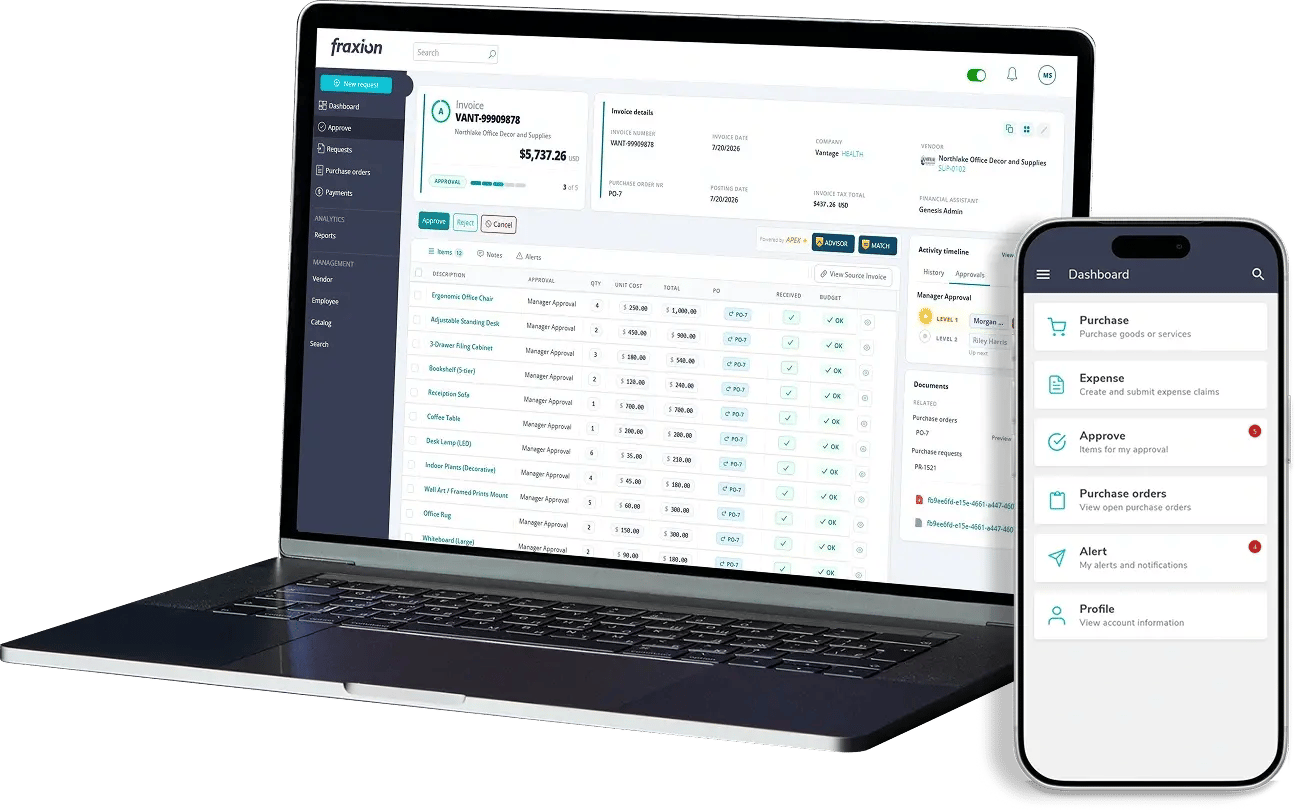
Fraxion is a SOC 2 compliant cloud-based procure-to-pay platform designed to bring structure and visibility to purchasing workflows. While many organizations initially adopt it for purchase order management, the platform connects the entire purchasing process—from request submission and approvals to purchase order creation and invoice matching.
This approach makes it particularly useful for mid-sized organizations where purchasing decisions occur across multiple departments but finance still needs oversight and auditability.
Industries such as education, agriculture, biotechnology, and nonprofits frequently evaluate Fraxion because spending often spans multiple budgets, projects, or funding sources that require careful tracking.
Integrations
What sets Fraxion apart
One of Fraxion’s strengths is how it structures the purchasing process before the purchase order is created. Employees submit purchase requests through a guided workflow, approvals are routed automatically based on policy, and purchase orders are generated once the request has been authorized.
The platform also provides clear visibility into purchasing activity, allowing managers to track spending across departments, projects, and funding sources.
Fraxion’s mobile capabilities are another differentiator. Teams can submit requests, approve purchases, receive goods, and review invoices from mobile devices, which is particularly useful for organizations with distributed teams or field operations.
Integration flexibility is another reason many mid-market organizations evaluate Fraxion. The platform connects with cloud, legacy, and niche accounting or ERP systems such as Sage, QuickBooks, Microsoft Dynamics, Xero, and NetSuite. It also supports more than 50 PunchOut catalog integrations and Microsoft Teams workflows.
Why choose Fraxion?
Fraxion gives mid-sized teams the structure they need to scale purchasing without losing control. It’s easy to use, and designed to eliminate manual inefficiencies, paperwork, delays, and rogue spend.
Whether teams are in the field, remote, traveling, or office-based, Fraxion enables mobile, accountable spending with robust integrations and processes that work from anywhere. And as processes and transaction volumes grow, Fraxion scales with your business. The platform simplifies complexity and keeps procurement efficient, transparent, and audit-ready.
Keep in mind
Fraxion is designed primarily for mid-sized organizations. Companies with highly complex sourcing operations or enterprise-level procurement needs may require platforms with deeper supplier management capabilities.
For very small teams with minimal purchasing volume, the platform may offer more functionality than necessary.
What customers are saying
“We primarily use Fraxion for POs and approving expenses. It seamlessly integrates into our MS Dynamics system, which helps make our workflow a lot quicker. We’ve eliminated something like 90 percent of our paperwork.”
–LaTasha, Senior Accountant, Charles R. Drew University of Medicine & Science
Effective spend control starts with the right tools. Get in touch with our team and see how Fraxion can automate your PO process.
2. Coupa: best for enterprises managing complex procurement operations
Coupa is an enterprise procurement platform designed for large organizations with complex purchasing environments. The system goes far beyond purchase order automation, offering tools for supplier management, sourcing, expense management, and procurement analytics.
For global organizations managing thousands of suppliers and large purchasing volumes, Coupa provides a centralized procurement environment supported by AI-driven insights.
Integrations
- Coupa integrates with major ERP systems such as SAP, Oracle, NetSuite, and Microsoft Dynamics.
What sets Coupa apart
Coupa’s strength lies in its enterprise procurement capabilities.
- AI-powered PO optimization: Coupa’s AI agents automate purchase order creation, approvals, and supplier matching. Helps reduce cycle times and improve accuracy through real-time, data-driven insights.
- Integrated PO and inventory management: Coupa syncs POs with inventory in real time to prevent duplicates and trigger replenishment only when needed.
- AI-powered spend insights: Coupa uses artificial intelligence to analyze spend patterns.
Why choose Coupa?
For large, distributed teams with complex procurement needs, Coupa delivers automation, control, and scale. It streamlines POs with real-time inventory integration, enforces compliance, and provides AI-powered insights to help you spend smarter and operate efficiently.
Keep in mind
Coupa’s breadth of functionality also introduces complexity. Implementation can require significant configuration and internal resources, which may make it less practical for smaller or mid-sized organizations with simpler purchasing workflows.
3. Spendwise: best for small teams replacing spreadsheet-based purchasing
Spendwise is a lightweight purchase order platform designed for small businesses transitioning away from manual purchasing processes. It focuses on simplifying PO creation, approval routing, and basic budget tracking without introducing unnecessary complexity.
For organizations that simply want a digital system to replace spreadsheets and track purchase orders more reliably, Spendwise provides a straightforward solution.
Integrations
- Spendwise integrates with QuickBooks and Amazon Business.
What sets Spendwise apart
The platform emphasizes simplicity and ease of use. Teams can create purchase orders quickly, route approvals, and track purchasing activity without extensive setup or training.
Spendwise also offers optional inventory tracking and basic reporting capabilities, making it suitable for smaller operations with limited procurement requirements.
Why choose Spendwise?
If your team is small, lean, and using spreadsheets to track purchases, Spendwise is a straightforward upgrade.
Keep in mind
- Spendwise offers limited scalability. It’s great for small teams, but it may not meet the needs of growing companies with complex workflows or high transaction volumes.
- Not designed for multi-entity reporting or advanced policy controls.
- Advanced features like custom workflows, deep reporting and analytics are not included in basic plans.
- Add-ons may be required. Inventory and ERP integrations are optional and may incur additional costs.
4. Kissflow Procurement Cloud: best for organizations needing customizable workflow automation
Kissflow Procurement Cloud is part of the broader Kissflow workflow automation platform and is designed for organizations that need flexibility in how procurement processes are structured.
The system supports purchase requests, approvals, purchase orders, and invoice workflows, all built on a no-code platform that allows organizations to design processes around their specific operational requirements.
Integrations
- Integrates with QuickBooks, Xero, SAP, Google Workspace, Slack, and more via connectors and API.
What sets Procurement Cloud apart
Its no-code workflow builder allows teams to create custom approval processes without relying heavily on IT support. This flexibility can be useful for organizations with unique purchasing structures or cross-department workflows.
Kissflow can also integrate procurement workflows with other business processes managed within the platform.
Why choose Procurement Cloud?
Kissflow Procurement Cloud is ideal for teams that want complete control over workflow design without IT dependency because it offers a combination of pre-built functionality and deep customization.
Keep in mind
- Setup can take time and require upfront effort.
- Advanced features (such as advanced analytics), may be limited, require add-ons, or custom development.
- It can take some time to get familiar with the layout and features, especially for new and non-technical users.
5. SAP Ariba: best for organizations managing large supplier networks
SAP Ariba is an enterprise procurement platform known for its supplier collaboration capabilities and global procurement infrastructure. It connects organizations to the Ariba Network, enabling buyers and suppliers to collaborate digitally across sourcing, contracting, and purchasing workflows.
For organizations already using SAP systems or managing large supplier ecosystems, Ariba provides deep procurement functionality.
Integrations
- Native with SAP S/4HANA and SAP ERP; supports Microsoft Dynamics, Oracle, and others via middleware.
What sets SAP Ariba apart
The Ariba Network allows organizations to collaborate with suppliers through a shared platform, improving communication around purchase orders, invoices, and contracts.
The system also supports contract-linked purchasing, ensuring that purchase orders align with negotiated supplier agreements.
Why choose SAP Ariba?
SAP Ariba is ideal for large organizations that need to manage high volumes of purchase orders across multiple business units and geographies. It offers deep integration and broad supplier connectivity for global procurement teams already using SAP. Its strength lies in enabling seamless collaboration with suppliers, enforcing contract compliance, and providing full visibility into procurement operations.
Keep in mind
SAP Ariba is designed primarily for large organizations with dedicated procurement teams. Its implementation, pricing, and complexity may be more than mid-sized companies require.
How to choose the right purchase order software for your organization
When comparing purchase order platforms, it helps to focus less on feature lists and more on how the purchasing workflow actually functions.
Look closely at how requests are submitted, how approvals are routed, and how purchase orders are generated once a purchase has been authorized. These operational details often determine whether employees adopt the system and whether finance gains the visibility it needs.
It is also worth evaluating how clearly the platform connects purchasing activity with budgets and financial systems. Integration with your accounting or ERP system is important for maintaining accurate financial records while reducing duplicate data entry.
Many organizations find that the best way to compare vendors is to walk through a real purchasing scenario during product demos. Seeing how a request moves from submission to approval to purchase order creation usually makes the differences between platforms much clearer.
Bring structure and visibility to your purchasing process with Fraxion
As organizations grow, purchasing activity often becomes more distributed across departments and teams. What once worked through spreadsheets or informal approvals can become difficult to manage without clearer processes and oversight.
Purchase order software helps bring structure to that environment by centralizing requests, enforcing approvals, and creating a reliable record of purchasing decisions.
For mid-sized organizations that need stronger purchasing controls without the complexity of enterprise procurement suites, platforms like Fraxion are often part of the evaluation process. By connecting purchase requests, approvals, purchase orders, and financial systems, these platforms help finance and operations teams maintain visibility into spending as the organization scales.
If you are currently evaluating purchase order software, exploring how these workflows function in a live environment can make the differences between platforms much easier to assess. Book a Fraxion demo here.
Choosing PO software FAQ:
1. How do we know if a simple PO tool is enough, or if we need a more structured procure-to-pay system?
Many organizations start by looking for software that simply digitizes requisitions to purchase orders. That works well when purchasing volume is low and approvals are straightforward.
However, if transaction volume is growing or multiple departments are making purchases, organizations may eventually need full procure-to-pay software that connects purchasing with accounts payable. Even if you start with just basic POs, it’s wise to look for a platform that can support AP automation in the future, so you won’t outgrow the system as your financial processes become more complex.
Platforms like Fraxion connect purchase requests, approvals, purchase orders, and invoices into a single workflow. And while you can start with core purchasing functionality, it’s easy to expand into broader procure-to-pay capabilities as your needs grow and you're ready to scale functionality.
2. How well does purchase order software typically integrate with accounting or ERP systems?
Integration varies widely. Basic PO tools may require manual exports, while advanced purchase order software connects directly to your accounting or ERP system, reducing errors and giving finance real-time visibility. When evaluating systems, look for platforms with flexible integrations that work with your current ERP—whether cloud-based or on-premise, so they meet your needs today and can easily scale as your organization grows.
Platforms designed for mid-market environments, such as Fraxion, support cloud, legacy, and niche ERP systems.
3. What makes one purchase order platform easier for employees to adopt than another?
Ease of adoption comes down to how simple and intuitive it is for employees to submit purchase requests. Platforms that streamline request submission, automate approvals, and provide a mobile app are far more likely to be used consistently.
Adoption is also higher when the system integrates with familiar tools like Microsoft Teams or other everyday apps, allowing employees to stay in the tools they already use. If the workflow is cumbersome or approvals are unclear, employees may bypass the system, causing finance to lose visibility and control.
Ease of use is one reason many mid-market organizations evaluate tools like Fraxion, Spendwise, and similar platforms that prioritize intuitive purchasing workflows.
4. How do finance teams maintain visibility into spending before purchase orders are issued?
In many organizations, purchase orders are only created after a purchasing decision has already been made.
Some purchasing platforms address this by introducing structured purchase requests and approval workflows before the PO stage. This allows managers to review purchases with visibility into available budget and committed spend.
Systems that connect requests, approvals, budgets, purchase orders into a single workflow provide proactive control and enable finance to manage spend before money leaves the organization.
5. When comparing PO system vendors, what usually becomes the deciding factor?
For many organizations, the final decision comes down to operational fit rather than individual features. Small teams often prioritize simplicity and quick deployment, while large enterprises may focus on supplier collaboration and global procurement capabilities. Mid-market organizations typically look for a balance: structured purchasing controls, real-time visibility into spend, seamless integration with existing financial systems, and a workflow employees will actually adopt, without the complexity of enterprise procurement suites.
Platforms like Fraxion often enter the conversation because they combine this balance with automation, proactive control, and the ability to scale as the organization grows.
6. What should finance teams evaluate before making a final decision?
Before choosing a purchase order platform, finance teams should focus on real-world validation rather than just feature lists. Look for customer reviews and references to see how similar organizations have successfully implemented and used the system. Request a customized demo tailored to your business processes and industry, so your team can experience how the platform handles real-world scenarios. Seeing the workflow in action helps determine if it truly fits your operational needs, encourages employee adoption, and delivers the visibility and control finance requires.
.webp)