According to a 2025 Candid analysis, non-profits receive 62% more in contributions if they are transparent about how funds are used. Donors reward organizations that can show where every dollar goes and that it’s allocated responsibly.
Yet in many non-profit finance offices, the transparency (on which their funding largely relies) still depends on spreadsheets, email approvals, paper-based records, and memory.
Transparency can’t be added at the end; it has to be built into how spending happens. When control depends on manual paperwork rather than structured processes, accountability usually arrives too late to catch mistakes or misallocations.
Why transparency breaks down in non-profit procurement
Transparency often slips at key stages of the spending process—purchase requests, purchase orders, expenses, and invoices. When each step is handled manually, visibility fades quickly due to fragmented records and the inability to verify spending until after payments are made.
- Fragmented funding sources make misallocations easy. A single request may touch three different grants—each with its own rules—and without fund codes enforced at submission, mistakes slip through. One mistagged expense can compromise compliance and add hours to audit preparation
- Manual approvals mean decisions get lost in inboxes. Finance can’t trace who signed off, when, or under which budget. Without a consistent workflow, accountability becomes anecdotal.
- Spreadsheets hide the real story. Manual spreadsheet‑based bookkeeping is error‑prone, and often leads to missing or incomplete records, unreconciled transactions, or incorrect allocations, especially in non-profit organizations with multiple grants or cost centers.
- Documentation silos delay reporting. Email request and approvals, purchase orders, and invoices live in different places, forcing finance to play detective with the paper trail.
None of these transparency pitfalls come from negligence. They are the result of relying on manual processes to enforce procurement policy. The intent may be transparency, but the system itself falls short.
How to build transparency into every step of the procurement process
Transparency starts with process, not reports—and automation is the key to embedding it from request to payment.
1. Avoid the reporting trap
Most non-profits equate transparency with better reporting. But reports only tell you what has already gone wrong.
The real problem? Finance sees the data too late. Purchases are coded only after payment, so at month-end “mystery transactions” appear with no clear link to their funding source.
Fix it at the start: include fund tagging in the purchase request. When each request specifies its grant or cost center upfront, accuracy happens automatically. The result is clean data, fewer reclassifications, and true visibility—before any money moves.
2. Build accountability into approval workflows
Approvals shouldn’t live in inboxes. When they do, finance loses control of timing, context, and proof.
Set clear, automated workflows instead: volunteer → program lead → finance manager. Each request follows the appropriate path automatically, with no reminders needed.
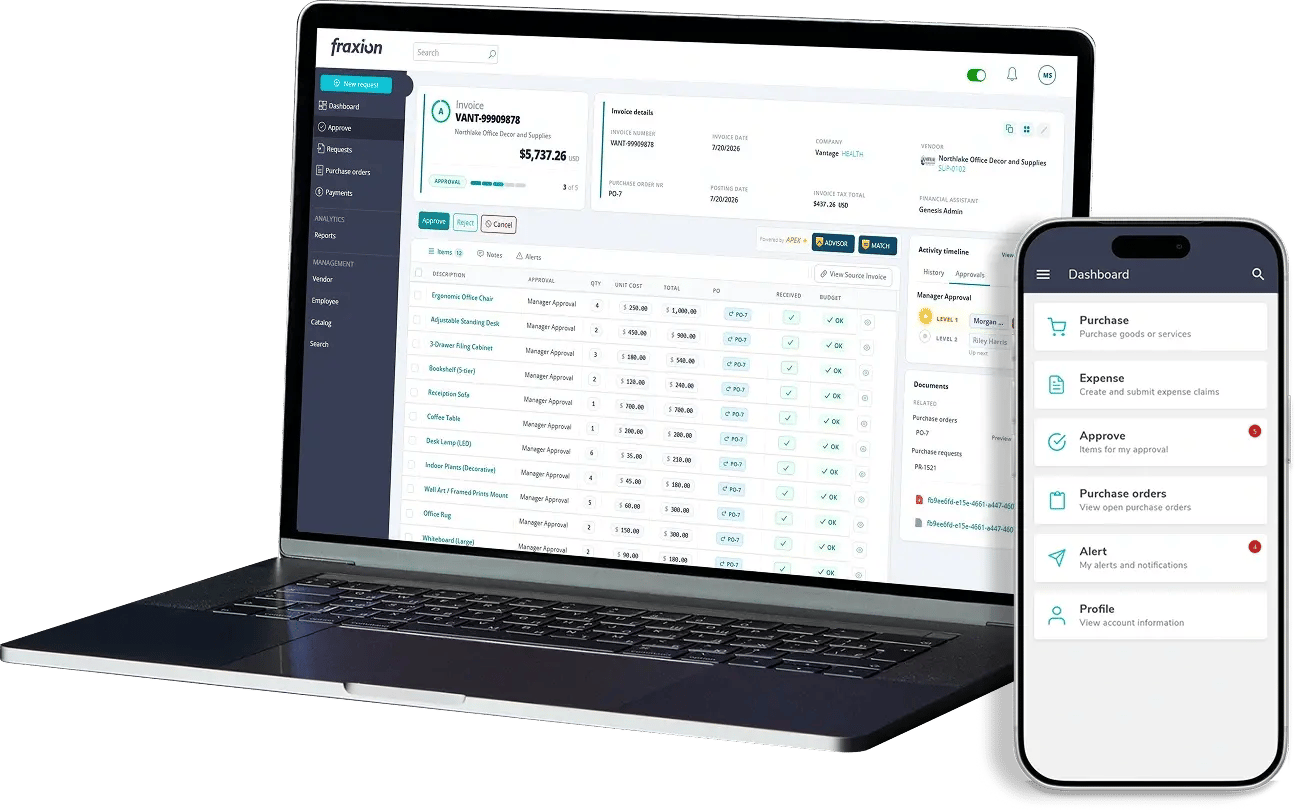
With Fraxion, approvals can happen wherever you are, at your desk via the web app, directly in Microsoft Teams, or on the mobile app for staff in the field. Finance sees every decision, timestamp, and comment in one place—creating an instant audit trail that’s faster than chasing sign-offs and it's fully compliant.

3. Enforce policy at the point of purchase
Compliance issues rarely start in the ledger—they begin when purchases bypass established policies, processes, or approvals.
Fraxion’s PunchOut catalogs solve that by directing orders to integrated vendor catalogs with live, pre-negotiated pricing. Staff shop as usual, but within the automated framework that enables budget checks, ensures approvals and policy compliance.
It’s the difference between “we’ll catch it later” and “it can’t happen in the first place.” No off-contract spend, no fund drift, and no surprises during reconciliation.
4. Make every audit painless
Audit pressure rarely stems from the transactions themselves, but from the chase to justify them. Receipts live in folders, comments in emails, and finance ends up piecing together proof weeks or months later.
Fraxion keeps it all in one system. Every request, approval, and purchasing record is automatically stored and searchable. When a funder asks for evidence, it’s already there—no panic, no scramble, just clarity.
Fraxion: transparency that protects trust and time
For non-profits, transparency isn’t just a reporting requirement—it’s essential to maintaining trust with donors, boards, and stakeholders. Fraxion embeds that transparency directly into the flow of non-profits spending.
Every purchase request is linked to its funding source, ensuring grants and restricted funds are used correctly. Approvals follow automated workflows based on roles and departments, often handled seamlessly within Microsoft Teams or via the mobile app for field staff. Staff shop confidently through approved PunchOut catalogs, while finance has a complete, audit-ready view of every decision, document, and transaction.
Fraxion also manages expenses, per diems, and cash advances—common requirements for non-profits—while linking every transaction to the appropriate cost center, budget, or fund. Each step is fully tracked, creating a complete audit trail that ensures compliance, simplifies reporting, and gives finance real-time visibility into all spending.
The result? Non-profits no longer need to reconstruct spending or prove compliance after the fact. Instead, trust is built in real time, and finance teams reclaim hours once lost to manual reconciliation—freeing them to focus on mission-driven work.
Book a demo to see how Fraxion builds accountability into every request, purchase, and invoice, so you’re audit-ready from day one.
FAQs
Why is transparency such a challenge in non-profit procurement?
Transparency in non-profit procurement is difficult because finance teams often rely on manual tools—email approvals, spreadsheets, and disconnected systems. With these processes, policy compliance isn’t enforced as purchases happen, and finance only discovers issues after the fact, leaving visibility and control lagging behind spending.
How can non-profits ensure accountability when managing multiple grants or funding sources?
Non-profits can ensure accountability by linking every purchase request to a specific fund or grant before approval. This keeps restricted and unrestricted spending separate from the start and ensures finance doesn’t have to fix errors later. In short, accountability is achieved when fund coding happens at the outset, not during reconciliation.
What’s the difference between reporting transparency and process transparency?
Reporting transparency means sharing financial results after the fact, while process transparency means having visibility and control during each step of the purchasing cycle. The key difference is timing—reporting transparency explains what happened; process transparency prevents missteps before they happen and holds team members accountable in real time.
How does automation improve non-profit transparency?
Automation improves non-profit transparency by providing complete spend vs fund / grant tracking and enforcing policies at the point of action or decision— tagging funds at request, checking budget availability before approving, requesting quotes for the best pricing, routing approvals automatically, and having a complete digital audit trail of every step. Put simply, automation shifts transparency from a reporting task to a built-in outcome of daily operations.
How does Fraxion help non-profits stay accountable to funders and auditors?
Fraxion helps non-profits stay accountable by embedding control into their workflows. Every request is tagged to its funding source, spending stays within budget, approvals route through the correct chain from any device or location, and each step—comments, attachments, timestamps, approvals—is stored automatically in a full audit trail. This means non-profits can demonstrate compliance and financial stewardship instantly, instead of recreating it at audit time.