Most finance and AP teams can spot the problems in their process long before leadership does. You see the late approvals. You experience the slow invoice turnarounds. You clean up the coding mistakes. And you carry the pressure of keeping vendors paid on time without the tools that make the job any easier.
The challenge isn’t knowing the process needs improvement. It’s getting leaders to see the urgency too.
Here’s how to frame that conversation so it lands.
1. Show why manual AP is holding the business back
You don’t need to open with fear or frustration. Leaders respond when you tie the pain to the business, not the workflow.
To strengthen your argument, you can point to the numbers:
- Manual or low-automation teams spend $12.88 per invoice, where highly automated teams spend $2.78.
- Invoice cycle times stretch to 17.4 days without automation, compared to 3.1 days for automated teams.
- Exception rates nearly double in manual workflows, pushing more rework back onto finance.
The numbers speak for themselves: labor drives the majority of AP costs, and manual work multiplies with every touchpoint. Each year, more mid-sized companies automate AP, recognizing that the cost of staying manual grows faster than the investment required to fix it.
Your next step is simple. Show how the current process holds the company back, not how it holds you back.
2. Identify the immediate pain AP automation can fix
Start by calling out one of the needs that AP automation can fix right away. Don’t lead with features. Lead with benefits: something automation improves on day one. Leaders move faster when they see a clear win instead of a long roadmap.
A single pain point is enough to open the door. Choose the one that impacts the business where it matters most:
- Missed early-payment discounts as invoices linger in inboxes, directly impacting cash flow
- Coding mistakes that trigger rework, increasing labor costs and the risk of misallocated funds.
- Slow invoice turnarounds that frustrate vendors, potentially leading to late fees or lost preferential terms.
- Manual invoice matching that drags on for weeks or months, causing delayed payments and strained vendor relationships.
- Month-end delays from missing context or manual reconciliations, driving overtime and inefficiencies.
- Exceptions piling up because requesters aren’t guided from the start, causing avoidable overpayments or compliance issues.
Instead of explaining the system's capabilities, highlight the one problem automation removes immediately.
.svg)
3. Bring the case to life with a real story
Once you’ve identified the problem, show its real impact. Stories engage people because they show impact rather than just describing it, giving leaders something tangible to connect with.
One compelling example can go further than ten bullet points of facts. It helps leaders understand the friction you experience every month, and it shows exactly how automation can prevent these issues before they arise.
If you want something stronger, leverage one of Fraxion’s case studies.
4. Choose the internal champion who can move this forward
Every successful internal pitch begins with the right ally. You don’t need a committee—just one person who recognizes the same pain points and has the influence to engage others.
Think about who feels the weight of manual AP the most. A controller who keeps closing late. A CFO who wants more accuracy and savings. An AP manager who spends half the week correcting coding or chasing approvals. One of them already knows the process can’t keep running the way it does today.
Have a quiet conversation before escalating and ask:
- What slows your work the most?
- Which AP problems get traction when they’re raised?
- Would they support a change if the case is solid?
Be inclusive across experience and titles—many seasoned leaders are open to new tools once they understand the potential financial benefits.
Fraxion: a modern AP automation platform built for accuracy and control
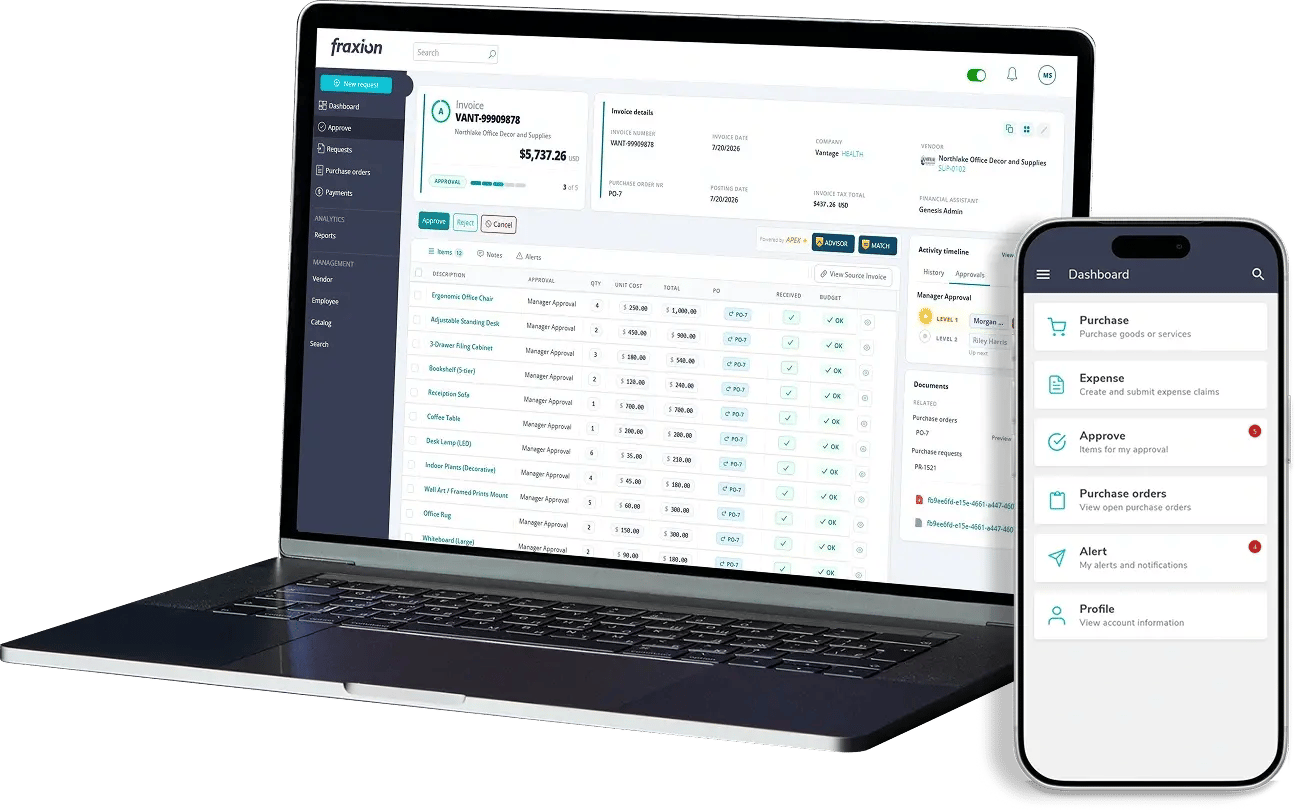
To demonstrate a tangible improvement to leadership, highlight how Fraxion strengthens the AP process by enforcing controls at every step, reducing errors that cost time, budget, and organizational trust.
Here’s what that looks like in practice:
- Coding stays accurate because staff tag the right fund or project upfront, not after the invoice arrives.
- Approvals follow the correct path without depending on emails and are based on cost center, amount, or department.
- Invoices match to the original request automatically, which reduces exceptions and protects AP from missing context and overpaying.
- Every action leaves a built-in audit trail, giving finance a clean record without week-end compiling.
- ERP data stays aligned, keeping budgets, vendors, coding, and transactions in sync across both systems.
Seeing the controls in action makes the decision far easier. Book a demo to show leadership how Fraxion reduces rework, tightens financial controls, and keeps AP accurate without the need to expand your team.
FAQs
How do I convince leadership that AP automation is a business priority?
Convincing leadership that AP automation is a business priority starts with tying the pain to business outcomes, not workflow complaints. Use facts leaders recognize, like the cost to process an invoice, the cycle time delays, and the exception rate your team deals with every month. When you show how manual AP affects cash flow, vendor relationships, and financial accuracy, automation becomes a business conversation rather than a system request.
What’s the simplest way to show the value of AP automation?
The simplest way to show the value of AP automation is to highlight one immediate problem the business can fix right away. Leaders respond to clear wins: faster invoice turnaround, fewer coding errors, better discount capture, or reduced exceptions and costs. When you frame automation as the solution to a specific, costly pain point, the value becomes obvious.
Why do stories work better than data alone when pitching AP automation?
Stories resonate more than data when pitching AP automation—they show the real impact on daily work, cash flow, and vendor relationships. A concrete, real-world example—a late payment, a coding mistake, a vendor escalation—helps leadership picture the real cost of staying manual. A story turns an abstract problem into something they can remember and repeat internally, which moves the conversation forward faster.
Who should champion AP automation inside the company?
The person who should champion AP automation is the one who feels the strain of manual AP the most: the controller trying to close on time, the CFO who wants more accuracy and savings, or the AP manager who spends hours correcting coding or chasing approvals. A single strong advocate has more influence than a large committee, especially when they can speak directly to financial risk or operational inefficiency.
How does Fraxion support a stronger AP process than manual or partially automated workflows?
Fraxion strengthens your AP process by enforcing controls at every step. Coding is applied upfront, the approvals route correctly without relying on email, and invoice data is captured quickly and accurately. Fraxion’s AP automation reduces exceptions, duplicate payments, rework and keeps financial data accurate—all without adding headcount.
.webp)