Operations slow down the moment accounts payable (AP) slows down. A late payment can stall a delivery, push a project off schedule, or force teams into costly workarounds. That’s why AP isn’t just a back-office task; it’s a core part of controlling operating risk and keeping financial priorities stable.
Many mid-size organizations, however, still don’t take the steps needed to keep AP efficient over the long run, even as their purchasing volume grows or more locations come online. The process keeps moving, but not always at the speed the field depends on.
Benchmarking gives you a clear way to see whether your AP team is performing at the level your operations require. They provide hard indicators that reveal where time, cost, or control may be slipping.
Benchmarking: the fastest way to spot inefficiencies before they become costly
Benchmarks reveal gaps quickly: slow cycle times, high exceptions, or manual steps that have crept in over the years. Once the numbers are on the table, it becomes a lot easier to see what needs attention and where improvements will have the biggest payoff.
If your results fall short of what mid-market peers are reporting, that’s usually the cue to dig into the root causes and tighten up what’s dragging performance down. You’re not aiming for perfection; you’re aiming for a process that keeps your locations supplied, on schedule, and free from preventable bottlenecks.
The 4 metrics that reveal whether your AP team is truly high-performing
1. Process costs: the hidden expense draining budget and time
Cost-per-invoice looks simple until you try to measure it. Every organization includes a different mix of tasks in the total: collecting and opening invoices, routing them for approval, handling exceptions, chasing missing details, and correcting coding before anything reaches the ledger.
Once those steps are factored in, the number climbs quickly. Mid-market benchmarks show a large difference between teams that still rely on manual routines and those that have tightened the process with better controls and automation.
Industry‑wide surveys in 2025 suggest that manual invoice processing can cost between $10–$15 per invoice, the median is approximately $6, while automated/AP‑automation‑enabled processing often sees that cost drop to $2–$3 per invoice.
Two indicators complement process cost in revealing whether the process is drifting: how many invoices each AP staff member handles in a month, and how long it takes to fully process one.
For operations leaders, these indicators matter because they show whether AP can keep up with the pace of daily work. When each invoice takes too long or each staff member manages only a small volume, the entire purchasing cycle slows down, and the delays land as interrupted orders, missed timelines, and mounting frustration.
2. Error rates: how small mistakes become expensive problems
Even a small mistake in AP leaves a long trail behind it. One miscoded invoice can throw off a budget line, delay a payment, or trigger a back-and-forth with a vendor who’s already waiting on a delivery confirmation. Multiply that across a month’s volume and the cost becomes real: lost time, extra work, and relationships that gradually wear down.
Cross-industry benchmarking from the APQC shows that top-performing organizations (75th percentile) achieve 98% of disbursements are error-free. While the difference between average and top performance may seem small, it scales quickly. For mid-sized organizations processing thousands of invoices each month, each percentage point represents tens of thousands of dollars tied up in corrections, rework, and disputes.
Teams that reach this level of accuracy typically rely on standardized workflows, strong controls, and higher levels of automation to reduce manual handling and prevent errors before they move downstream.
By monitoring this metric teams can fix issues earlier because they see the link between accuracy and operational stability. The goal is to maintain a low error rate so that AP processes flow smoothly, avoid delays, and ensure vendors receive timely and accurate payments.
.svg)
3. Fraud & duplicate payments: the red flags most teams miss
According to the 2025 Association for Financial Professionals (AFP) Payments Fraud and Control Survey, 79% of organizations reported being victims of attempted or actual payments‑fraud activity in 2024.
Duplicate payments and erroneous disbursements make up a measurable share of total payments across organizations. In APQC’s benchmarking data, even high‑performing teams report nearly 0.8 % of payments as duplicate or erroneous, while less efficient teams can see this figure rise toward 2 % — amounts that can still represent significant cash and labor costs when scaled across thousands of invoices.
Vendor master files naturally grow more complex over time, often collecting duplicate records, inactive suppliers, and inconsistent entries. Without careful management, this can lead to errors, duplicate payments, and higher fraud risk. To maintain accuracy, organizations should regularly remove inactive vendors, enforce consistent naming and onboarding procedures, and perform routine data quality audits.
Teams that stay ahead don’t rely solely on cleanup efforts. They maintain tight vendor records by reviewing them frequently and limiting who can create or modify entries. Most control comes from clear approval rules and role-based permissions, which prevent unauthorized vendors from being added and ensure every change is intentional. Automated invoice matching further reduces the risk of duplicate or suspicious payments.
4. Automation: the one change that delivers the biggest AP efficiency gains
A 2025 AP automation survey found that only 5% of AP departments are fully automated, while 68% still rely on manual invoice data entry. Even with broader adoption of digital tools, the majority of teams haven’t completed the transition — meaning significant inefficiencies and error risk remain.
End-to-end automation cuts processing costs by as much as 60–80%, but partial automation tends to shift work from one step to another instead of removing it.
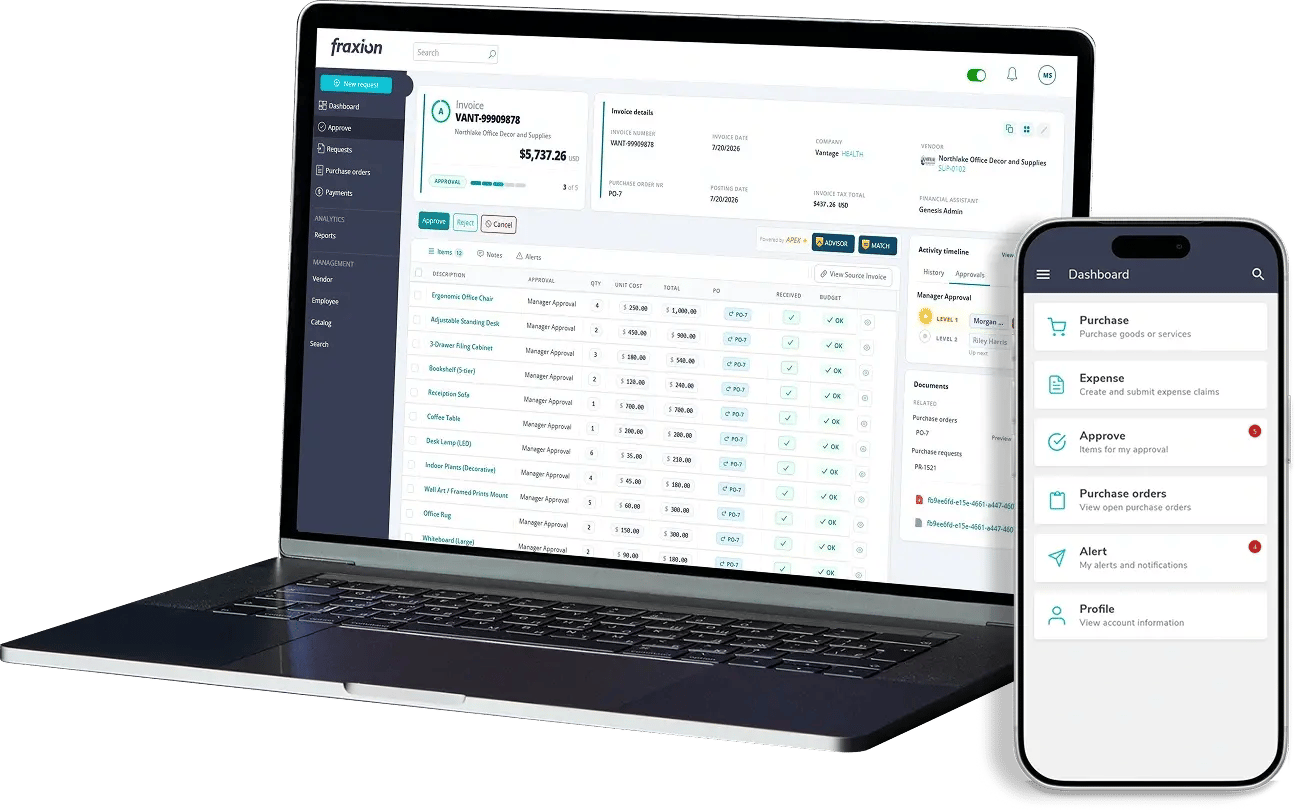
The organizations that come out ahead capture invoices digitally, match them automatically, route approvals via workflows, and move exceptions straight to the right person. Once those pieces line up, AP stops being a bottleneck and becomes a predictable flow the organization can trust. That’s where modern AP automation platforms start to show their real value.
How Fraxion eliminates the biggest barriers to AP performance
- Requests enter the process clean, because budget checks, role-based approvals, and policy rules are initiated at the point of request—not after an invoice arrives—so AP spends less time correcting upstream mistakes.
- Invoices move through faster, with digital capture, matching, and clear routing removing the slow handoffs.
- Exceptions reach the right person immediately, keeping teams supplied and preventing the back-and-forth that usually stretches a simple issue into days of delay.
- Every action is recorded, giving finance the audit trail they need and helping multi-location teams keep spending consistent without adding more oversight.
- Visibility stays in one place, so teams can see what’s approved, what’s pending, and what’s already spent—reducing surprises and tightening control over working capital.
- Invoice approvals on-the-go — via the mobile app, preventing delays and bottlenecks.
- Peer benchmarking with community insights — Fraxion’s embedded spend‑analytics platform lets you compare your organization’s spend and AP patterns and process efficiency against mid‑market peers and top performers, helping you identify opportunities to tighten controls and drive savings.
Book a demo to see how Fraxion helps teams move faster, stay in policy, and keep AP performance on track.
FAQs
How do I know if our AP process is actually underperforming?
You know an AP process is underperforming when core benchmarks—cost per invoice, error rate, cycle time, or duplicate payments—fall outside industry norms. Most mid-size teams assume their process is “normal” because it hasn’t completely broken, but benchmarking often reveals hidden delays, high exception rates, or manual steps that don’t show up in month-end reports.
Why does our AP cost per invoice seem high even though we’ve made improvements?
AP cost per invoice often stays high because teams count only the visible work: the part they can see someone doing, like keying in an invoice into the system or reviewing a line item. The full cost sits in everything that happens around that step: waiting for approvals, routing delays between locations, correcting coding, resolving mismatches, answering vendor calls, and chasing missing information. When those upstream issues stay untouched, the total cost remains high even if the more obvious tasks look cleaner.
What kinds of AP errors actually cost us the most?
The errors that cost the most are the ones that disrupt downstream steps—miscoded invoices, quantity mismatches, missing approvals, and discrepancies that trigger overpayment and vendor disputes. These problems look small on paper but compound across thousands of invoices, pulling staff into rework, slowing deliveries to the business, and raising costs.
Why do duplicate payments keep happening even when we have controls in place?
Duplicate payments happen when vendor records aren’t maintained tightly and when matching, approvals, or coding rules aren’t applied consistently. Even with controls, duplicates slip through if data is entered manually or if different locations follow slightly different routines. AI-driven invoice capture, electronic receiving and matching, and automated approval workflows catch most of these issues early.
How do invoice discrepancies affect our relationship with vendors?
Invoice discrepancies affect vendors by creating uncertainty around payment timing. Discrepancies and exceptions are the top driver of supplier inquiries, which often lead to delayed shipments, stricter terms, or service interruptions. A consistent AP workflow reduces these calls and ensures both fulfillment and invoice-to-payment cycles stay on schedule.”
Is partial AP automation worth it, or do we need full automation to see results?
Partial AP automation rarely delivers meaningful results because it shifts work instead of reducing it. Industry benchmarks suggest that fully end-to-end automation — covering capture, matching, routing, coding, and exception handling — can reduce AP processing costs by 60–80%. Partial automation often fails to eliminate bottlenecks.