AP automation
7 Manual AP mistakes that delay invoice approvals
Manual AP processing creates errors, bottlenecks, and hidden costs. See the 7 mistakes slowing your invoice approvals and how accounts payable...

Manual invoice processing breaks across five distinct stages: intake, data capture, three-way matching, approval routing, and ERP posting. At each stage, errors compound into the next, and the cumulative effect is a delayed month-end close, post-close corrections, and reduced visibility into accounts payable. Invoice automation prevents these bottlenecks by standardizing validation, matching, and approval logic to reduce month-end close time.
Finance teams see the same pattern: invoices arrive through email, supplier portals, or paper. Each invoice is opened, data is entered, exceptions are flagged, approvals are routed, and details are matched against purchase orders and receipts before being coded for payment. A single data entry error — missing information, a typo, or a misdirected approval— can stall an invoice. What starts as a small intake problem often leads to approval delays, posting errors, and longer close cycles. The issue is not a single point of failure. Manual invoice processing is inefficient across multiple stages, and each stage compounds delays, errors, and rework in the next.
The five stages below highlight where the bottlenecks occur and how invoice automation prevents them at each step.
The problem: When invoices arrive, the first task is extracting key details like invoice number, vendor, amount, date, PO reference, and line-item details. In manual workflows, this is done by reading each invoice and entering the data by hand. But invoices arrive in many different formats—PDFs, emails, scanned documents, and poorly structured files—often missing key information. The real bottleneck isn’t volume, it’s inconsistency in invoice formats and quality. A 1,000-invoice month does not fail because of volume. It fails because most of those invoices require manual interpretation and correction before they can be validated.
How automation fixes it: At intake, invoice automation uses AI to capture and structure data from invoices in multiple formats, including electronic files and handwritten documents. It extracts and reviews key details such as vendor, amount, date, and reference information, and structures them for processing or ERP entry. If information is missing or unclear, the system flags it for review. Most invoices move through without manual intervention and continue directly into matching and approval workflows.
The outcome: Invoices enter your system already structured, complete, and validation-ready. Your team handles exceptions, not manual data entry, reducing processing time from hours to minutes.
The problem: A vendor submits an invoice for $12,000. In manual processing, it is entered incorrectly as $120,000. The error is typically caught during invoice matching against the purchase order and receipt. The invoice is then flagged for investigation, requiring review of the original document, correction of the entry, and reprocessing—creating delays that can slow down overall invoice throughput.
Manual data entry introduces a predictable level of error in invoice processing. Industry estimates place manual entry error rates at around 1–3%, depending on process complexity and controls. In a 1,000-invoice close, this can result in 10 to 30 exceptions requiring review or correction. Each exception requires human intervention, and the longer it takes to identify, the more time is spent investigating, correcting, and reprocessing the invoice.
How automation fixes it: AI data extraction captures invoice details such as amounts, dates, and references with higher accuracy than manual entry. More importantly, it validates extracted data against known fields in real time. If an invoice amount differs significantly from the PO, the system flags it at intake, not after a three-way match. If a vendor name does not match your active vendor list, the system prompts correction before the invoice enters the flow.
The outcome: Errors are identified at intake, not later in the validation process. Corrections take minutes instead of days. Your three-way match report is clear and post-close corrections reduce.
The problem: Invoices still need to be validated before they are approved for payment. This includes checking invoice details against available purchase orders (where they exist) and receipt information (where captured), ensuring amounts, vendors, and quantities align. In many environments, this validation is done manually by comparing documents side by side.
When done manually, AP teams or approvers must locate supporting documents, compare invoice details line by line, confirm receipt of goods or services, and resolve any discrepancies. High-volume or complex invoices such as partial deliveries, pricing adjustments, or missing references can take significant time to investigate and resolve.
How automation fixes it: If you manage purchase orders and receiving in the same system, the platform brings invoice, PO, and receipt data together in a single validation view—flagging discrepancies early and giving AP teams the context needed to review, query, and resolve issues before approval.
The outcome: Routine invoices move through validation quickly, while exceptions are clearly identified and documented. Time spent investigating mismatches is reduced, and approval decisions are made with full visibility into supporting data. Matching becomes a control point within the process, not a manual reconciliation exercise after the fact.
The problem: Invoices that pass intake, extraction review, and matching still need approval. Most organizations route approvals based on cost thresholds: for example, under $500 may auto-approve, $500–$5,000 requires a manager, and higher values require controller approval. But vendors invoice inconsistently. A single purchase order (PO) might generate multiple partial invoices that fall under approval thresholds. Credit notes might require different routing. Some invoices lack PO references entirely.
Manual routing workflows rely on email and spreadsheets. An AP clerk forwards an invoice to an approver, but it gets buried in a busy inbox. Follow-ups are needed and days pass. By the time the approval is received, the invoice often misses the current close window.
How automation fixes it: Automated approval routing applies configured approval rules to incoming invoices. Based on key factors such as amount or cost center, the system routes invoices to the appropriate approver in sequence. Approvals are tracked in-system, with full visibility into status and history. Where approvals are delayed, reminders and escalation rules can be applied based on organizational settings.
The outcome: Invoices move through approval workflows in days or hours, not weeks. Approvers see a clear list of invoices awaiting action. Finance has full visibility into approval status, outstanding actions, and where delays are occurring. Approval cycles that typically take several days can often be reduced to one to a few days in automated workflows.
The problem: Once an invoice is matched, approved, and ready for processing, it still needs to post to your ERP as an accounts payable liability. In a manual workflow, the invoice is then re-entered into the ERP, creating an additional point of data entry and another opportunity for error. If the invoice has already been captured in a spreadsheet or middleware system, this second entry also introduces duplication, increasing the risk of mismatched records and sync issues between systems.
This final manual step means your ERP data often lags behind real activity. Controllers and finance teams run month-end close knowing the system reflects what has been entered, not necessarily what has actually been processed.
How automation fixes it: Direct ERP integration connects invoice capture to posting. Data extracted at intake flows directly into your ERP's accounts payable module. There is no re-entry, no intermediate spreadsheet, no manual sync. Once an invoice is matched and approved, it is posted automatically. The vendor liability is recorded, GL accounts are updated, and the invoice is available for payment processing. Syncing frequency depends on the integration setup. In many ERP and AP environments, data syncs at scheduled intervals throughout the day API-based integrations can have near real-time updates.
The outcome: More current visibility into accounts payable. Fewer post-close corrections caused by entry errors or missing information. Finance gains a more accurate view of AP aging and liabilities earlier in the close cycle, helping reduce delays and improve close efficiency.
When these stages work together — intake, capture, matching, approvals, and posting — the close process becomes more controlled and predictable. Instead of chasing invoices, following up on approvals, and resolving entry errors during the close window, finance teams can focus on analysis and accrual adjustments.
You have clear visibility into which invoices are in progress, which approvals are outstanding, and where exceptions exist. Matching and validation processes run with more complete and consistent data, reducing the need for last-minute corrections.
For many mid-market finance teams, this can shorten the close window by several days, depending on process maturity. It also reduces post-close adjustments, which are a common source of audit queries and reconciliation work. The CFO and Controller gain more reliable accrual estimates because AP data is current and exceptions are visible throughout the process.
This reduces operational risks such as duplicate payments and overpayments by ensuring invoices move through a controlled, consistent workflow from intake through approval and posting. With fewer manual interventions and exceptions, invoices are processed on time and with greater accuracy.
As a result, supplier payments are more predictable and timely, strengthening vendor relationships and improving the ability to capture early payment discounts where available.
As you assess invoice automation solutions, ask these specific questions.
Does it reduce human touches at intake? Look for solutions that use AI data extraction to capture key invoice data from PDFs, scans, and other formats without manual data entry. The system should extract, validate, and structure core fields such as vendor, amount, and reference information, and flag exceptions for review when data is missing or uncertain.
Does it embed your approval logic? The system should let you define routing rules based on amount, cost center, and approval hierarchies. It should enforce those rules and escalate if approvals are delayed.
Does it validate invoices before approval? Look for solutions that bring purchase orders, receipt information, and vendor records into a single validation view, where they exist. The system should flag discrepancies, document exceptions, and give approvers the context to confirm or correct invoices before they move forward.
Does it post back to your ERP? Look for solutions that post approved invoices directly into your ERPs accounts payable module through integrated workflows. This removes manual entry and reduces reliance on batch exports or delayed sync processes.
Does it give you visibility during the close? You should see invoice status in a single dashboard or view. You should know which invoices are stalled and why.
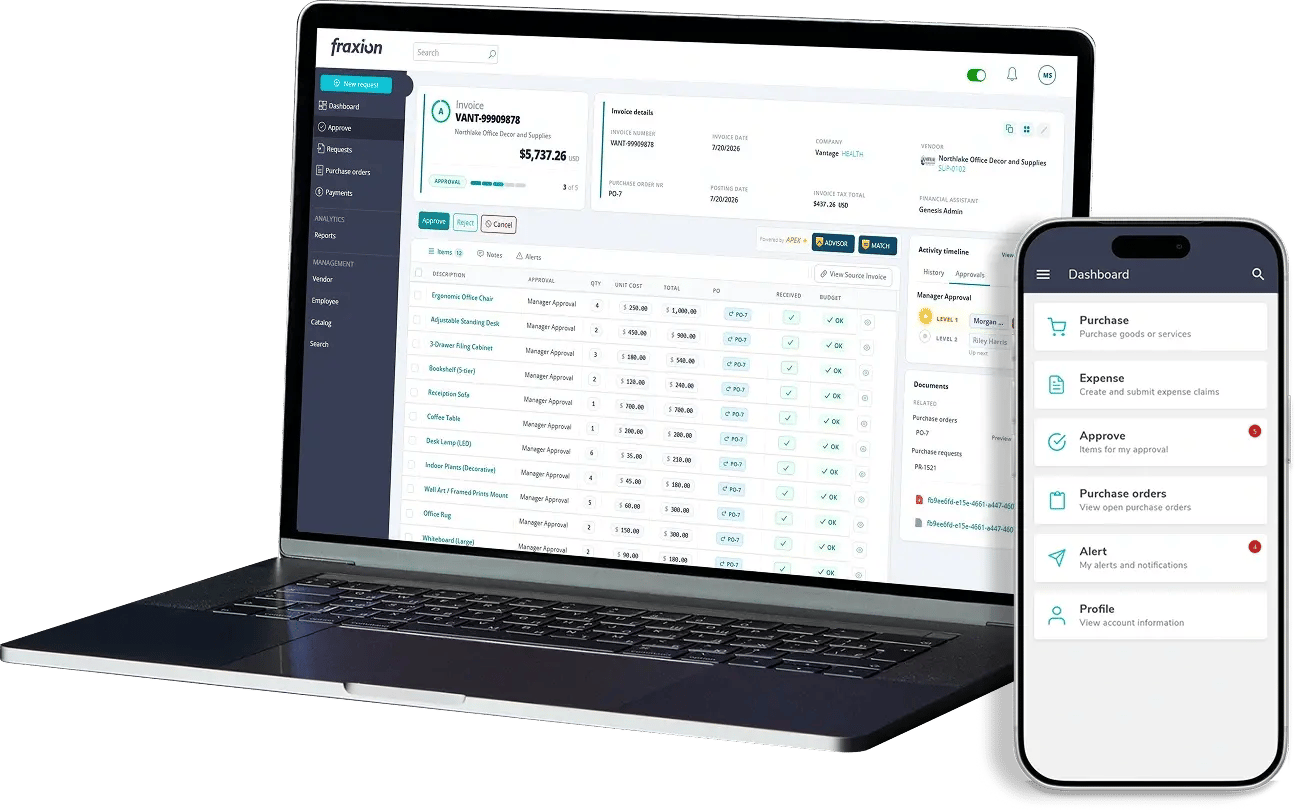
A platform that addresses all five stages and ensures clean, auditable data at each point will transform your close timeline and give your finance team time back for higher-value work. Explore Fraxion's invoice automation solution and how it connects to your current ERP and procurement process, enabling a seamless path to procure-to-pay as your needs evolve.
How are invoices handled when they arrive in different formats?
Invoice automation supports multiple intake methods, including email, drag-and-drop, and upload. Once received, AI is used to extract data from multiple formats such as PDFs, scanned documents, and even handwritten invoices. Key fields and line-item data are extracted and validated, with potential errors and inconsistencies flagged for review. This reduces manual effort, errors, and helps identify exceptions earlier in the process.
Does invoice automation replace our ERP's AP module?
No. It extends your ERP. Your ERP remains the system of record for general ledger, vendor master, and payment processing. Invoice automation streamlines the AP process by managing intake, capture, matching, and approvals, areas where ERPs are typically not designed to efficiently handle high-volume or multi-format invoice processing. Once invoices are approved, they are posted to the ERP as accounts payable entries, where they move through your standard payment process.
What happens if our approval rules change?
You can update routing rules in the automation system without stopping the workflow. New invoices route according to the updated rules. Invoices already in approval continue according to the rules active when submitted. This prevents confusion mid-close and ensures consistent routing within a close cycle.
How much time do we save with invoice automation?
In a typical mid-market environment, invoice automation can significantly reduce manual invoice processing time by reducing data entry, approvals, and exception handling. They can reduce overall processing effort by 50–80% compared to manual workflows, depending on maturity and level of automation.
The greatest time savings typically come from reducing follow-up work such as chasing approvals, correcting data entry errors, and resolving discrepancies, which together represent a substantial portion of month-end AP effort.
What if AI data extraction misreads an invoice?
The system flags unclear or incomplete extractions for human review. Reviewers can quickly verify and correct extracted data across multiple invoices, significantly reducing the effort compared to manual data entry and review. Over time, the system can also improve recognition accuracy by learning from recurring corrections and vendor-specific patterns.
How does invoice automation integrate with our ERP?
Invoice automation connects to your ERP by synchronizing core master data such as vendors, accounts, dimensions, tax rates, currencies, budgets, and spend data, depending on ERP and configuration. It manages invoice intake, AI extraction, validation, matching, routing, and approvals. Approved invoices are then posted into the ERP as AP entries for accounting and payment processing.
What if we have complex approval chains or cost-center routing?
Invoice automation supports multi-step approval workflows, conditional routing, and auto escalation rules. Invoices can be routed based on amount, cost center, or custom attributes.
How does invoice automation affect our month-end close timeline?
Many teams are able to shorten their close window by several days as data is cleaner, more current, and already validated. This also helps reduce post-close corrections caused by entry errors or missing documentation. As a result, the CFO and Controller gain a more accurate view of AP aging and accrual balances earlier in the close process.
Manual AP processing creates errors, bottlenecks, and hidden costs. See the 7 mistakes slowing your invoice approvals and how accounts payable...
AI-driven AP automation prevents overpayments through duplicate detection, extraction accuracy, vendor validation, and approval workflows.
Learn how invoice approval works, why manual processes slow AP teams down, and what to look for when automating invoice approvals.
Get our latest content, updates, and how-to resources delivered to your inbox.
Book a demo to see how Fraxion can assist your organization.
Book a demo