Healthcare and life sciences organizations operate in highly complex environments, juggling urgent clinical needs, regulatory requirements, multiple funding sources, and constant exceptions. It’s no surprise that some healthcare teams hesitate to implement procure-to-pay (P2P) automation, fearing disruption or difficulty handling unique cases.
Yet automation is increasingly critical for hospitals, clinics, and research labs that need to provide transparent, auditable reporting to boards, funders, and regulators. By replacing fragmented manual procurement processes with structured workflows, automated P2P systems deliver real-time visibility into approvals, spending, and compliance, freeing healthcare teams to focus on patient care and research priorities. This guide debunks common healthcare P2P misconceptions and demonstrates how to implement an automated process that actually works.
Common misconceptions holding back healthcare and biotech procure-to-pay efficiency
#1: “Our ERP already handles procure-to-pay”
Enterprise Resource Planning (ERP) systems give a sense of comfort in healthcare because they capture purchase orders, invoices, and payments. On paper, it may seem like the full procure-to-pay chain is covered.
In practice, ERPs record transactions but don’t enforce the processes that generate them. They typically don’t flag policy violations during purchasing, and most lack automated invoice data extraction or robust exception detection. They record the result, not the process.
Example (Biotechnology): In research labs, grant-funded equipment or regulated materials may get purchased outside defined workflows. The ERP will log the payment but cannot enforce compliance with grant requirements or policies.
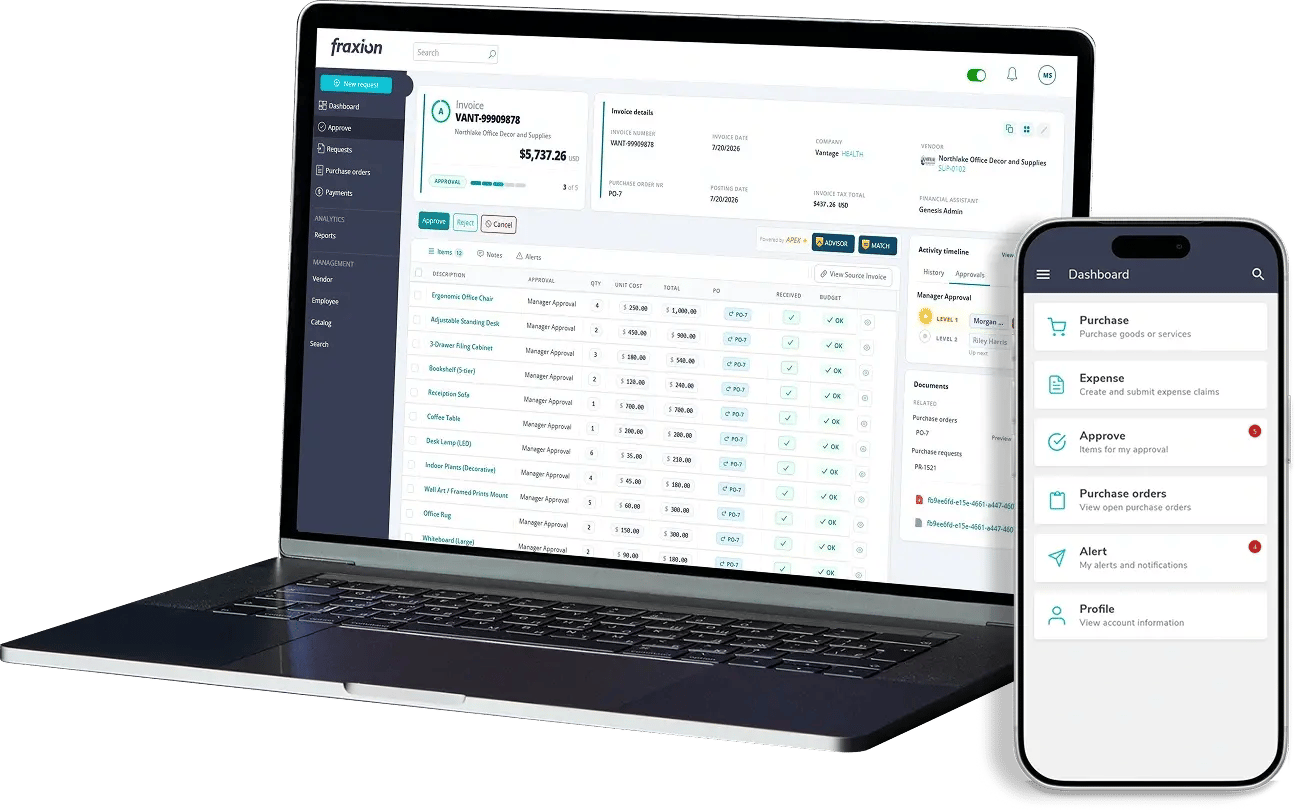
The fix: First, define a clear, standardized approval process that accounts for funding restrictions, vendor qualifications, and regulatory requirements. Then implement a procure-to-pay system like Fraxion, which drives compliance and transparency via automated workflows with internal controls:
- Requests for grant-funded or FDA-regulated items are flagged if they deviate from pre-approved vendors and catalogs, budgets, or rules.
- The system prevents purchases that don’t meet regulatory or grant criteria from moving forward until the right approvals are obtained.
- Every step leaves an audit trail, so finance can instantly see who requested, approved, or modified the transaction, helping labs stay fully compliant without slowing research.
#2: “Automation will slow clinical teams down”
Clinicians and lab staff already juggle multiple systems. Introducing automation can feel like adding more logins, approval levels, or delays between a patient or research project’s needs and the necessary supplies.
Automation itself does not slow teams—it highlights existing bottlenecks. When workflows are clean and approvals follow defined paths, requests move faster, reducing the need for follow-ups, reminders, or guesswork.
Example (Life sciences): A lab technician ordering critical reagents no longer has to track multiple emails or phone approvals. The automated workflow routes the request to the correct approvers, ensuring the order is fulfilled on time without bypassing policy.
Here's what Jason Schnieder, Associate Director Operations at a healthcare organization said about Fraxion's procure-to-pay software:
“Our timelines are very tight, our projects aren’t something where we order the same thing over and over again. We’re requesting specialized items on a regular basis. So, it’s important in our day-to-day operations that purchase orders flow through our system quickly and efficiently.
With Fraxion, we just enter the info in the system, even from remote locations. Everything goes through the whole approval process automatically. Most orders only take one to two minutes to complete. What’s more, Fraxion interfaces seamlessly with our finance system. And keeps the full approval flow, so it’s easy for auditors to see that everything’s correct."
“We definitely get a good return on investment, that’s for sure.”
Jason Schnieder | Associate Director Operations, aTyr Pharma
Read the full case study here
#3: “Standardized workflows are too rigid for healthcare”
Hospitals and labs deal with a mix of routine orders, urgent exceptions, and department-specific needs. Standardization is often misinterpreted as blocking exceptions.
The right automated process, however, uses logic based on value, spending limits, vendor approval, and purchasing categories. Routine orders move through effortlessly, while unusual or high-risk requests receive the necessary oversight.
Example (Biotechnology): Standard consumables for a multi-site lab may flow automatically through the system, while high-value equipment triggers additional approvals tied to grant codes or compliance checks.
#4: “We’ll catch the issues at month-end”
Many finance teams rely on month-end reconciliation to clean up mistakes. By then, errors are frozen in the ledger: misallocated spend, off-policy purchases, and missing documentation must be pieced together manually.
Month-end reconciliation is reactive—it cannot prevent overspending or compliance issues.
Example (Hospital/Clinic): A department orders a set of surgical supplies via email without linking to a cost center or verifying the vendor is approved or contracted. By the time finance notices it during month-end reconciliation, the purchase has already hit the ledger, the budget is overspent, and the off-contract supplier means the hospital paid a higher price.
The fix: Implement checks at the start of an automated workflow. Each request should be linked to a relevant cost center, project, or funding source. The system should enable budget visibility and tracking capabilities and trigger an approval workflow before any money moves. Early visibility prevents duplicate orders, overspending, enforces compliance, and ensures corrective action happens before funds are committed.
What healthcare teams gain with automated process and policy-driven P2P
A structured healthcare procure-to-pay workflow doesn’t just speed requests—it maintains control and accountability across the organization. By automating processes with Fraxion’s procure-to-pay system for healthcare, you gain:
- Faster approvals: Requests move quickly via the tools staff already use, reducing delays in clinical or lab supply chains.
- Accurate, transparent data: Every request is linked and tracked against its funding source, budget, and cost center from the start, eliminating guesswork and reducing month-end reconciliation and reporting burden.
- Vendor approvals and compliant purchasing: Automation ensures purchasing from approved vendors at pre-negotiated prices via internal catalog hosting and PunchOut integrations (with vendors such as ZAGENO, McKesson, Amazon, Fischer Scientific, and Sigma Aldrich). Keeping staff purchasing on policy while streamlining budget adherence and approvals.
- Auditability and compliance: Automation records every request, document, approval, and change, creating a complete digital audit trail.
- Advanced analytics and reporting: Finance teams gain real-time insight into all spending—by grant, budget, or cost center while boards, funders and auditors see exactly where money goes. Analytics highlight opportunities to reduce costs, improve processes, and capture savings across the organization.
- Internal controls enforced by the system: Role-based access, matching, and exception alerts minimize the risk of fraud, overpayment, or misallocation.
- Secure, SOC-2 compliant cloud environment: Ensures data integrity and security.
- Ease of use: Encourages adoption across clinical and research teams, maintaining compliance and accountability organization-wide.
P2P automation delivers real value when paired with workflows that are accountable, transparent, and auditable. It simplifies work while preventing errors, reducing risk, ensuring compliance, and keeping spending under control.
If you'd like to see a demo, customized to your hospital or research lab's needs, book a Fraxion demo today.
FAQ
Why do healthcare procure-to-pay processes break down?
Healthcare procure-to-pay processes often break down because critical steps—approvals, receiving, coding, and routing still rely on emails, memory, or manual workarounds. When decisions occur outside a controlled, automated workflow, spending is misallocated, visibility and control are lost, and delays and overspending become inevitable.
Does an ERP fully manage procure-to-pay processes for hospitals or research labs?
Not entirely. While ERPs track transactions and handle basic POs, invoices, and payments, they typically lack automation for requisitions, policy compliance checks, invoice capture, detailed exception handling, and real-time budget or spend visibility—critical for complex environments like hospitals and research labs. In short, ERPs record transactions, but cannot proactively control spend or enforce workflow compliance.
Will P2P automation slow clinical and research teams down?
No—when implemented correctly, procure-to-pay automation speeds up processes. By handling routine tasks like approvals, purchase orders, and invoice extraction and processing, automation reduces manual work, errors, and email back-and-forth, giving staff more time to focus on patient care or research. The key is ensuring workflows are intuitive, mobile-friendly, and integrated into daily processes so teams can work efficiently without added steps.
Are standardized workflows realistic for hospitals, clinics, or labs with constant exceptions?
Yes. Through customizations, organizations can create adaptable logic for values, spending limits, vendor status, and purchasing categories—not forcing all requests down one rigid path. Automated workflows handle exceptions reliably while keeping routine orders moving smoothly.
Can automated P2P help with grant compliance in research labs?
Yes. Automated P2P systems let you track and report on spending by budget, grant, or fund while ensuring policy compliance. Built-in audit trails provide full accountability and complete visibility into each purchasing step and transaction.