AP automation
5 AP bottlenecks delaying month-end close
Manual AP bottlenecks delay month-end close by several days. Invoice automation prevents issues across intake, capture, matching, approvals, and...

Invoice approval is the stage where a received invoice is reviewed, assessed, routed to the appropriate approver, and approved before payment. Invoice approval software supports this process, giving AP teams a structured way to move invoices from receipt to payment.
In many organizations, invoice approval still follows a process like this: invoices arrive, someone captures or enters the information manually, codes them, matches them against the relevant purchase order and goods received and sends them out for approval by email or spreadsheet. Then the wait begins, follow-up messages go out, and eventually the invoice is released for payment.
Invoice approval is the process of moving a received invoice through review and authorization before it's released for payment. It's a specific stage within accounts payable, which in turn forms part of the broader procure-to-pay process and overall spend management. This article focuses specifically on the approval step, not the full AP function.
Depending on an organization's policies and whether a purchase order exists for a given invoice, invoice approval may involve:
Not every invoice follows exactly the same path. Workflows vary depending on the organization's policies and whether a corresponding purchase order exists for that invoice. Fraxion refers to this capability as automated invoice approvals.
A typical invoice approval follows a sequence like this:
The invoice is received.
Invoice information is captured and coded.
The invoice is matched against the purchase order, where one exists, and the goods received note (GRN) where three-way matching is used. The purchase order confirms what was ordered, while the GRN confirms what was received. Not every invoice has a corresponding PO, and not every organization uses three-way matching, so the checks performed depend on the transaction and how the organization's process is configured.
The invoice is routed to the appropriate approver.
The approver reviews and approves or flags the invoice.
Exceptions are resolved where required.
The approved invoice is released for payment.
Not every system automates every step of this sequence, and the specifics depend on the platform and how an organization has configured its approval rules. The overall process, however, tends to follow a similar pattern across most invoice approval workflows.
Email-based, spreadsheet-based, or paper-based invoice approval tends to run into a familiar set of problems:
Manual data entry, which adds administrative work on top of the approval itself
Manual matching across locations, making it harder to consistently verify invoices against purchase orders and goods received.
Missing supporting documents, causing delays, making discrepancies harder to identify, and increasing the risk of duplicate, incorrect, or fraudulent payments.
Invoices sitting unactioned in inboxes, simply waiting for someone to notice them
Limited visibility into where a given invoice currently sits in the approval process
Repeated follow-up and chasing, as someone has to track down outstanding approvals
Approval bottlenecks, particularly when a single approver is unavailable
Difficulty identifying exceptions before they turn into larger payment errors
Increased risk of duplicate payments or payment errors, since there's no structured check across the process
Missed early-payment discount opportunities, where they apply, if approval takes longer than the discount window allows
Difficulty reconstructing the approval history, which can slow down audit preparation
Manual approval doesn't automatically cause every one of these problems for every organization, but it does make them more likely as invoice volume and complexity grow. The underlying issue usually isn't that the process is manual in itself, it's that it lacks structured routing, visibility, control, and accountability.
Fast approval turnaround, so invoices don't sit waiting unnecessarily
Clear routing to the correct approver
PO matching where applicable, checking invoices against purchase orders and goods received
Exception handling, flagging discrepancies before they become payment errors
Budget and policy controls, keeping spend within approved limits
Visibility into invoice status, so AP teams and requesters can see where things stand
Clear approval accountability, documenting who approved what and when
A complete audit trail, supporting compliance and audit review
There's no universal invoice volume at which automation becomes necessary. It depends on whether the current process is creating enough delay, administrative work, risk, or lack of visibility to justify the change. That said, a few common indicators suggest it may be time to look at automation:
Invoice volume has increased
Data entry and coding errors are increasing
More departments are submitting or approving invoices
There are multiple approval levels involved
Invoices require two- or three-way matching
AP staff spend significant time chasing approvals
Finance teams lack visibility into invoice status and bottlenecks
Approval policies are difficult to enforce consistently
Approval delays are affecting payment timing
Overpayment and duplicate invoices are increasing
Audit preparation requires manually reconstructing approval histories
Exceptions are difficult to identify and manage consistently
The organization needs to handle growing volume without adding AP headcount
If several of these sound familiar, it's worth looking at what a real-world automated process can look like in practice. See how Monson Fruit eliminated its invoice backlog with Fraxion.
What does invoice approval software do?
Invoice approval software helps route invoices through a structured approval process, supporting review, matching where applicable, approval, exception handling, and auditability before payment.
How is invoice approval software different from accounts payable software?
Invoice approval is one component of the broader accounts payable process. AP software may cover a wider range of activities, including areas outside approval, while invoice approval software focuses specifically on getting invoices reviewed and authorized.
Can invoice approval software integrate with an existing ERP or accounting system?
Integration capability varies by platform and implementation. Where supported, integration can allow invoice and approval information to move between the procurement or AP workflow and the organization's finance system.
How long does invoice approval software take to implement?
Implementation can typically be completed within three months, although the timeframe varies according to workflow complexity, integrations, approval rules, data requirements, and the existing finance environment.
Can invoice approval software handle invoices without a purchase order?
This depends on the organization's workflow and the specific software's capabilities. Not every invoice requires a purchase order, and approval processes can typically be configured to handle both PO-backed and non-PO invoices.
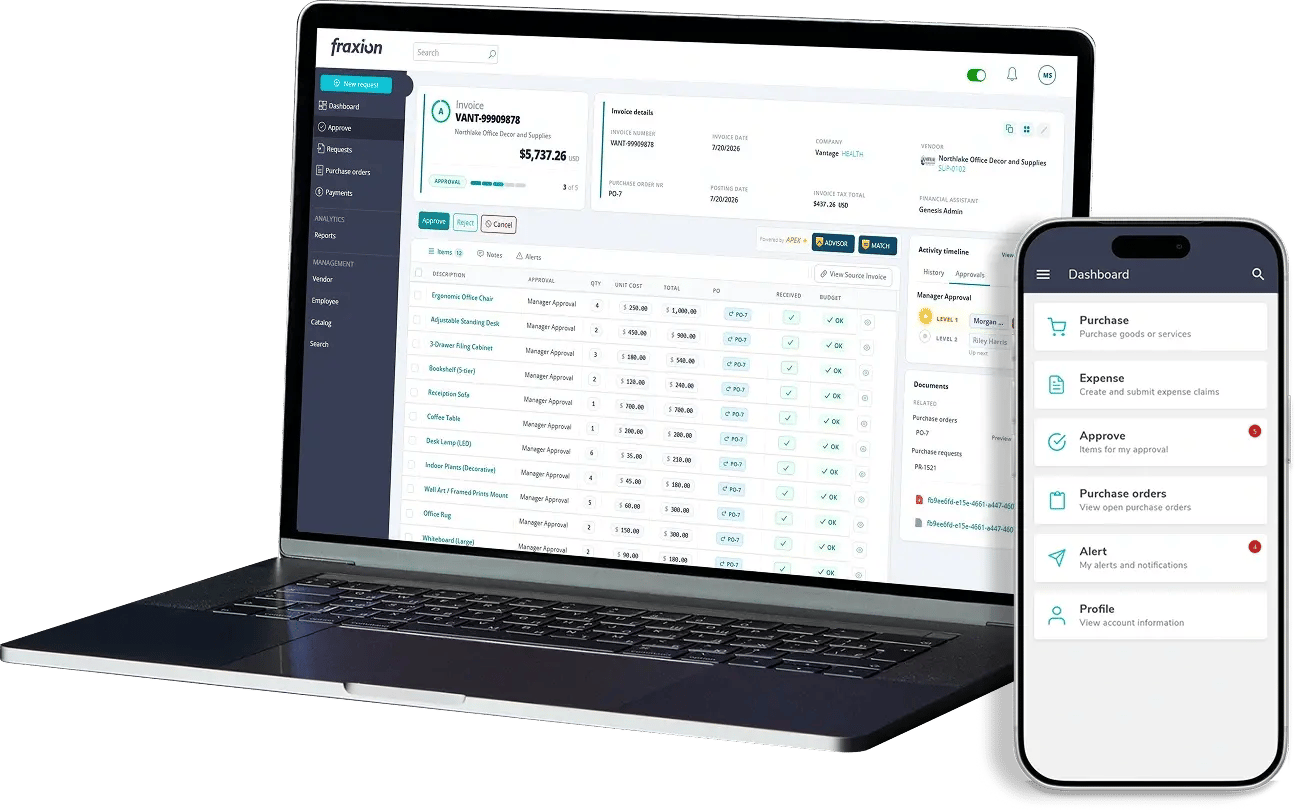
Fraxion is an all-in-one procure-to-pay solution for mid-market companies. Its accounts payable automation capabilities support the process from invoice intake through approval and payment. AI-powered data extraction captures invoice information for review and coding, while automated matching compares invoices against purchase orders and goods received. Budget and policy controls help identify potential issues, and automated approval workflows route invoices to the right approvers for action on the web or mobile app. AI-assisted guidance throughout the process helps flag exceptions and assess risk, while keeping final decisions with your finance team.
Invoice approval is one part of the broader procure-to-pay process. Finance teams can start with procurement or AP automation and expand to full procure-to-pay as their needs grow, without reimplementation.
To see how invoice approval connects to purchase order approval, read the aTyr Pharma purchase order automation case study.
Manual AP bottlenecks delay month-end close by several days. Invoice automation prevents issues across intake, capture, matching, approvals, and...
Introducing Fraxion's latest addition to the procure-to-pay suite, invoice batching. Streamline how you group multiple approved invoices into a...
Manual AP processing creates errors, bottlenecks, and hidden costs. See the 7 mistakes slowing your invoice approvals and how accounts payable...
Get our latest content, updates, and how-to resources delivered to your inbox.
Book a demo to see how Fraxion can assist your organization.
Book a demo