Cloud
How procurement tools improve collaboration between departments
Learn how procurement tools foster collaboration to maximize efficiency, visibility and cost-management throughout the procurement cycle.

Most mid-market finance teams arrive at the same realization at roughly the same point: the way they buy is the slowest, most error-prone, least visible part of how money leaves the building. Purchase requests sit in inboxes for days. Approvals depend on whoever happens to read the email first. Invoices arrive without matching POs, and someone in AP becomes a part-time detective trying to reconcile what was actually ordered. The procurement function works in the same way that a stack of paper still works as a filing system, which is to say it works until it doesn’t.
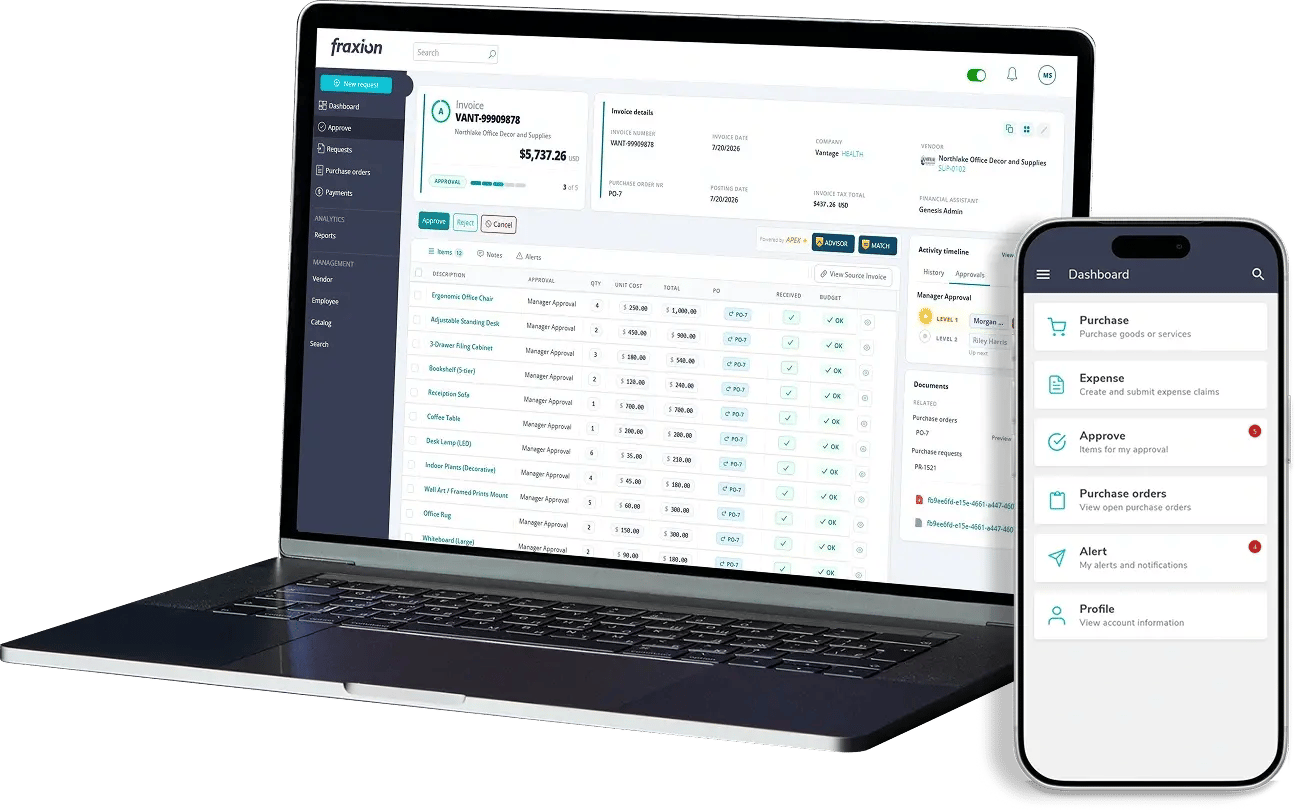
E-procurement software replaces that arrangement with a single procure-to-pay (P2P) system that runs the full workflow: requisition, approval, PO generation, goods receipt, invoice capture, three-way matching against the PO and goods received note, and posting to the ERP. Every step is recorded, every approval is rules-driven, and every transaction creates structured data the moment it happens rather than weeks later when AP catches up. This is what distinguishes e-procurement from a purchase requisition tool bolted onto an ERP, or an AP automation layer that only catches problems at the invoice stage. The category integrates intake, control, and posting in one system.
The benefits below are the ones mid-market organizations actually realize within twelve to eighteen months of deploying purchasing software of this kind. Numbers come from common implementation outcomes; specifics will vary by starting point, vendor mix, and process discipline.
The payoff: most organizations see total procurement spend drop 5 to 10% within the first full year. For a company spending $10 million a year through procurement, that is between $500,000 and $1 million captured back into the business. The savings come from four sources: vendor consolidation, reduced maverick spend, contract compliance, and automation of low-value transactions that were previously absorbing staff time without producing value.
How it works: e-procurement gives finance and procurement complete visibility into who buys what, from whom, at what price. That visibility is the precondition for every consolidation and renegotiation decision that follows. When you can see that five departments are each buying office supplies from a different vendor, you can consolidate. When you can see that 18% of spend is going to suppliers outside your master agreement, you can close those leaks. None of that analysis is possible when purchasing happens in spreadsheets and email.
The payoff: typical procurement cycle time drops from 7 to 15 days down to 2 to 5 days for routine purchases, and from days to hours for low-value pre-approved items. For organizations that compete on operational responsiveness or have field teams waiting on equipment, that difference shows up directly in revenue, productivity, and morale.
How it works: most of the elapsed time in manual procurement is wait time, not work time. A request sits in an approver’s inbox until they happen to look at it. A PO sits in someone’s queue waiting for finance to assign a GL code. The vendor address gets looked up by hand. E-procurement compresses all of this through rules-based routing, automatic GL coding, pre-loaded vendor master data, and threshold-based auto-approval for purchases that fall under defined limits. Routine transactions stop competing for human attention, and the humans involved get to focus on the exceptions that actually need judgment.
The payoff: organizations typically reduce procurement and AP administrative effort by 20 to 30%. That capacity rarely shows up as headcount reduction. It shows up as the same team handling growing transaction volume without hiring, or being redeployed to category management, supplier development, and analysis that previously got skipped because nobody had time.
How it works: the work that disappears is the work nobody wanted to be doing. Routing approval emails. Re-entering vendor data into the AP system. Hunting for the PO that matches a particular invoice. Calling departments to find out whether goods actually arrived. Generating ad-hoc reports for executives who want to know where the spend is going this quarter. E-procurement folds all of this into automated workflow steps that produce both the action and the audit trail simultaneously, removing the entire category of duplicate manual work that connects existing systems together.
The payoff: organizations in regulated industries report 80 to 90% reductions in compliance exceptions after moving to e-procurement, because the system enforces policy at the moment of transaction rather than catching violations weeks later in audit review. For finance leaders who spend significant time on quarterly compliance reporting, the shift is qualitative as well as quantitative.
How it works: every policy lives inside the workflow. Purchases over a defined threshold automatically require a second approver. Purchases must select from approved vendors, with exceptions requiring documented justification. Invoices cannot post until they pass three-way matching against the PO, the goods received note, and the invoice itself. Spending that exceeds budget is blocked or escalated based on configured rules. Compliance becomes a property of the system rather than a quarterly exercise. When auditors arrive, they get the trail without anyone reconstructing it.
The payoff: instead of seeing what happened 30 to 60 days ago, after invoices have been processed and posted, finance leaders see commitments at the moment they are made. That changes what financial planning can do. Rolling forecasts work with current data. Department heads can be challenged on commitments before the cash leaves. Quarter-end stops being an exercise in reconstructing what already happened.
How it works: every requisition, approval, PO, receipt, and invoice creates a structured record at the moment it happens. Dashboards reflect spend in real time, categorized by vendor, GL account, department, project, or cost center. The lag between economic activity and visibility, which is the structural defect of email-and-spreadsheet procurement, simply goes away. Finance does not have to wait for AP to catch up to know what was committed, because the commitment was the trigger that created the record in the first place.
The payoff: vendors operating with a mid-market customer that has e-procurement get faster, more predictable interactions with that customer. POs arrive with complete information. Invoices clear three-way matching cleanly. Payment terms get honored more consistently. Over time, this translates into better pricing, priority service, and access to volume discounts that vendors hold back from harder-to-work-with accounts.
How it works: vendor portals give suppliers direct visibility into PO status, invoice receipt, and payment timing. Disputes about whether something was ordered, received, or paid get resolved with reference to a shared system rather than competing email chains. The vendor experience improves not because anyone is being nice but because the underlying transactions are clean. Vendors notice which of their customers have their procurement house in order, and they price accordingly.
The payoff: after twelve to eighteen months of clean transaction data, organizations have the analytical foundation to make sourcing decisions based on evidence rather than relationship inertia. Categories that were managed by intuition can be analyzed quantitatively. Renewal negotiations have data behind them. Strategic sourcing exercises start from a complete picture of current spend rather than a partial reconstruction.
How it works: e-procurement systems produce structured data continuously. Spend by category, vendor, region, department, and time period is queryable without anyone running a special report. Trend analysis identifies categories where consolidation is now feasible, vendors whose share of spend has grown without commensurate scrutiny, and pricing that has drifted away from contracted terms. The analysis itself is not new. What changes is the data foundation it rests on, which is now reliable enough to make consequential decisions on.
The platforms in this category vary widely in fit for mid-market specifically. Enterprise systems like SAP Ariba and Coupa target large organizations and bring implementation complexity that often exceeds what a 100 to 1,000 employee company can absorb. Tools at the small-business end skip the controls that mid-market finance leaders actually need: budget enforcement, multi-level approvals, ERP integration, audit trails. The narrow band of solutions designed for the middle is where mid-market buyers should focus.
Five specifications matter more than the rest. Requisition-first design means the system starts at the point of need rather than the point of invoice, with buyers, approvers, and AP all working from the same record initiated at the requisition stage. Native budget control checks available budget at the moment of requisition and prevents or escalates purchases that would exceed it, which is structurally different from variance reporting after the fact. Configurable approval workflows handle the dimensions mid-market organizations actually use, including department, project, dollar threshold, GL category, and cost center, without requiring custom code or consultant engagements for every change. ERP integration that goes beyond export means PO data, vendor master, GL coding, and posting flow bidirectionally with NetSuite, Microsoft Dynamics, Sage Intacct, or SAP Business One without manual reconciliation. AI-driven invoice capture extracts invoice data using machine learning trained on commercial invoice formats, rather than older template-based extraction that requires per-vendor configuration to read each new layout.
These five dimensions narrow the field considerably and tend to surface a small number of mid-market-focused vendors. Beyond them, factors like implementation timeline, customer references at similar size, and pricing model become the deciding criteria.
The cost of staying with manual procurement is rarely accounted for explicitly because it shows up as small inefficiencies distributed across many people: an extra hour of AP time per day, a few days of cycle time, a small percentage of off-contract spend, an audit finding here and there. Aggregated over a fiscal year, those distributed costs are typically larger than the licensing and implementation cost of e-procurement, which is why the ROI math tends to work even on conservative assumptions.
The harder cost to quantify is the strategic one. A finance and procurement function that spends most of its capacity on transaction processing has none left for the analytical work that actually moves margins. That is the opportunity cost of postponing the decision, and it compounds for as long as the postponement continues. Mid-market organizations evaluating e-procurement should expect a twelve to eighteen month path from implementation to full operational maturity, with measurable benefits emerging in the first six months. The category has matured to the point where the question is no longer whether the technology works. It is which platform fits a given organization’s process, ERP, and growth trajectory.
How much does e-procurement software typically cost for a mid-market organization?
Mid-market e-procurement platforms typically run $20,000 to $80,000 per year in software licensing, with implementation services adding $30,000 to $100,000 in the first year depending on complexity and ERP integration scope. The annual run-rate cost for a 200 to 500 employee organization tends to land in the $50,000 to $120,000 range once implementation is complete. Set against typical year-one savings of 5 to 10% on procurement spend, the math works for organizations with $5 million or more in annual procurement, often with payback inside 12 months. Smaller spend environments need to evaluate whether the operational benefits justify the cost independently of pure savings math.
Can our existing ERP handle e-procurement, or do we need a separate platform?
Most ERPs include some purchasing module, but few handle the operational front end well. The strengths of ERP-native purchasing tend to be on the financial side: PO records, invoice posting, GL coding. The weaknesses tend to be on the operational side: requisition workflows tied to budget and category, dynamic approval routing, vendor self-service, real-time policy enforcement, and AI-driven invoice capture. Most mid-market organizations end up running e-procurement software that integrates with the ERP rather than relying on the ERP module, because the operational gaps are where the actual ROI lives.
What’s the difference between e-procurement and procure-to-pay?
E-procurement is typically a subset of procure-to-pay. P2P refers to the full cycle from requisition through invoice posting; e-procurement often refers to the front-end portion that handles requisitioning, vendor selection, and PO issuance. The categories overlap heavily and many vendors use the terms interchangeably. The functional question worth asking is what the platform actually covers. A genuine procure-to-pay platform handles requisition, approval, PO generation, goods receipt, invoice capture, three-way matching against the PO and goods received note, and posting to the ERP. An e-procurement platform that stops at PO issuance leaves the back-end work in the ERP or a separate AP automation tool, which creates integration overhead.
How long does e-procurement implementation typically take?
Mid-market implementations typically run 12 to 18 months to reach full operational maturity, with measurable benefits emerging in the first 6 months. The first phase usually focuses on cataloging existing vendors and configuring approval workflows. The second phase deploys the system to a pilot group of users and refines based on adoption feedback. The third phase rolls out across the organization and begins enforcing policy at the transaction level. Implementations that try to compress this timeline below 6 months tend to skip the change management work that determines whether departments actually use the system.
We’re a smaller mid-market company. Is e-procurement overkill for us?
For organizations under roughly $5 million in annual procurement spend, the cost-benefit math gets tighter and depends more on operational considerations than pure savings. The savings case still works (5 to 10% on $5 million is $250,000 to $500,000 against typical platform costs of $50,000 to $80,000 annually) but the implementation effort represents a larger relative investment for a smaller team. Many organizations at this size run a lighter implementation focused on requisition workflow, budget enforcement, and AP automation, deferring more sophisticated supplier management and analytics until later. The question to ask is whether the operational pain of manual procurement is significant enough to justify the implementation effort.
How does e-procurement integrate with our existing AP automation tool?
If the AP automation tool is part of the same procure-to-pay platform, integration is native and the two layers share the same data model. If they are separate systems, integration depends on what data the AP tool exposes for matching against POs and receipts. The risk of running them as separate systems is that three-way matching becomes harder when PO data lives in one platform and invoice data lives in another, which often produces the kind of integration debt that makes audit and reporting difficult. Most organizations evaluating this question end up consolidating onto a single procure-to-pay platform over time, because the operational benefit of unified data outweighs the switching cost.
What happens if departments resist using a new e-procurement system?
Adoption resistance is the single biggest risk to implementation, and addressing it tends to determine whether the platform delivers benefits or sits underused. The most common pattern is that departments revert to email and spreadsheets for purchases they consider routine, which creates the maverick spend problem the platform was supposed to solve. Successful rollouts treat adoption as a deliberate workstream: starting with the categories where the manual process is most painful (so the new workflow feels like an improvement), training on real workflows rather than abstract features, and enforcing usage by routing invoices through the system rather than processing exceptions. Resistance usually shrinks once departments see the new workflow is faster than the old one.
Should we evaluate enterprise platforms or mid-market focused tools?
The enterprise platforms (SAP Ariba, Coupa, Oracle) are designed for organizations with thousands of users and significant procurement teams. Their implementation complexity, configuration depth, and total cost of ownership often exceed what a mid-market organization can effectively absorb. Mid-market focused platforms are designed around the constraints of smaller teams: lighter implementation, faster time to value, configuration through interface rather than custom code, and pricing scaled to mid-market budgets. The right evaluation question is not which platform has the most features, but which platform’s implementation timeline and operational model fit the organization that will actually run it.
Learn how procurement tools foster collaboration to maximize efficiency, visibility and cost-management throughout the procurement cycle.
Discover the top factors to consider when selecting procurement software to enhance efficiency, reduce costs, and ensure compliance in your...
Discover how a digital procurement software can help you optimize the procure-to-pay process, eliminate rogue spend, and identify savings...
Get our latest content, updates, and how-to resources delivered to your inbox.
Book a demo to see how Fraxion can assist your organization.
Book a demo