Finance teams evaluating procure-to-pay software are looking to accomplish one goal: improve visibility and control over purchasing while reducing the manual work that slows down accounts payable.
What is often less clear is which capabilities actually make the biggest difference once the system is in place. Vendors frequently present long lists of features, but not all of them address the operational problems finance teams deal with every day.
In practice, the most effective procure-to-pay platforms improve the process in a few critical places. They capture purchasing information earlier, enforce approvals consistently, validate budgets before spending occurs, and automate the invoice stage so accounts payable is not constantly resolving exceptions.
If your organization is evaluating procure-to-pay software, the following capabilities are the ones worth paying close attention to:
1. Structured purchase requests that capture complete information
A strong procure-to-pay system should begin with structured purchase requests that capture the essential details of a purchase before it moves forward. Employees should be able to submit requests through a simple workflow that records the vendor, expected cost, supporting documents, and the appropriate accounting or departmental coding.
This capability matters because many purchasing problems originate at the request stage. When purchases begin through informal emails or quick conversations with suppliers, the information finance needs often appears much later in the process, usually when the invoice arrives.
Look for procure-to-pay systems that make request submission easy via web, mobile app, or collaboration tool, while still capturing the information approvers and finance teams need. Some modern platforms use predictive AI to suggest expense categories or GL codes based on past purchases, which helps reduce manual work and improves consistency in how transactions are classified.
When requests start with complete information, the rest of the procure-to-pay process becomes far easier to manage.
2. Budget validation during the approval stage
Another capability worth prioritizing is real-time budget visibility during the approval process. Approvers should be able to see how a request affects the department’s available budget before the purchase is authorized.
Without this visibility, approvals can happen without a clear understanding of how much budget remains, and finance often discovers overspending only when invoices begin arriving later in the cycle.
The best procure-to-pay platforms display actuals, available budget, and committed spend within the request workflow so managers can evaluate purchases with full financial context.
Some solutions are also beginning to use AI-driven analytics to identify unusual spending patterns or emerging trends that may require attention, helping finance teams spot potential issues earlier.
When budgets are visible at the moment decisions are made, approvals become more informed and financial surprises are less likely.
3. Approval workflows that route requests automatically
Approval workflows are another capability worth evaluating carefully. In many organizations, purchase approvals still happen through email threads or chat messages, which makes it difficult to ensure requests consistently reach the right decision makers.
A procure-to-pay system should route purchase requests to the right approvers automatically, based on rules such as department, purchase value, approval thresholds, or project, so finance teams have a clear audit trail showing who requested, approved, and authorized the purchase. When a request is submitted, the system should know exactly who needs to review it and move the request through the escalating approval path without requiring manual intervention.
This structure helps ensure every purchase follows the organization’s approval policy while reducing the delays that often occur when requests get lost in inboxes.
Some platforms now use AI agents to assist with routing decisions by identifying the appropriate approvers based on historical approval patterns or vendor categories. This can help keep requests moving smoothly even as organizations grow or approval structures evolve.
It is also worth confirming that approvals can be completed easily with budget visibility from mobile devices. Full-featured mobile apps enable approvals for purchases, expenses, and invoices. For organizations with distributed teams or managers who travel frequently, mobile notifications and alerts make it much easier to keep requests moving by informing approvers when action is required.
4. Automatic purchase order creation after approval
Once a purchase request has been approved, the next step should happen automatically. The system should be able to generate a purchase order directly from the approved request, so the commitment is clearly documented and shared with the supplier.
This capability eliminates the need to manually create purchase orders or re-enter information that already exists in the request. It also ensures that vendors receive consistent documentation outlining the agreed pricing, quantities, and delivery expectations.
When evaluating procure-to-pay platforms, look for systems that allow purchase orders to be delivered directly to vendors and updated easily if something changes, such as a delivery date or quantity adjustment.
Maintaining a clear record of these changes and approvals is important because it allows finance and purchasing teams to see exactly what was approved and communicated to the vendor before the invoice arrives.
5. Guided buying that steers purchasing to approved vendors
Vendor selection can be another source of inconsistency when purchasing happens across multiple departments. Employees often choose suppliers based on familiarity or convenience, which can lead to fragmented vendor relationships and inconsistent pricing.
Guided buying capabilities help address this by steering employees toward approved suppliers during the purchasing process. Instead of searching externally for vendors, employees can choose from internal catalogs or supplier PunchOut integrations that connect directly to vendor systems.
This approach simplifies purchasing for employees while helping organizations maintain better control over vendor relationships and negotiated pricing.
When evaluating procure-to-pay solutions, look for platforms that make it easy to surface approved vendors and purchasing options at the moment employees are creating a request. The goal is to guide purchasing behavior without adding unnecessary complexity to the user experience.
6. AI-powered AP automation that reduces manual work
Accounts payable is often where the largest amount of manual effort still exists within the procure-to-pay cycle. Invoice data entry, coding, matching, and exception handling can quickly consume large amounts of time, especially when invoices arrive without clear purchasing documentation.
Procure-to-pay software with AI-powered accounts payable automation can significantly reduce these workloads and errors by capturing and reviewing invoice data automatically while only flagging exceptions that require further review.
Some systems also use AI agents to route invoices to the appropriate approvers and categorize transactions without requiring manual input from finance teams.
It is also important to evaluate how the platform handles invoice matching. When invoices can be matched against purchase orders and receiving records through two-way or three-way matching, discrepancies become easier to identify and invoice cycle times can be reduced.
The result is a much more manageable workload for accounts payable teams and a faster, more predictable and accurate invoice process.
7. Advanced analytics that provide real-time visibility into spending
Finally, reporting and analytics capabilities play a critical role in how effectively finance teams can oversee and influence organizational spending.
Modern procure-to-pay software should provide a single, central view of transactional spend, vendor and employee spend — giving finance leaders real-time visibility into how money is being spent across departments, budgets, and entities.
The real value, however, is in turning that visibility into action. Look for platforms that don’t just report spend, but help identify cost-saving opportunities, highlight budget risks, and surface trends — without needing a separate analytics tool.
More advanced solutions also enable peer or community benchmarking, helping organizations compare spend patterns and procurement processes against similar organizations to identify improvement opportunities.
The outcome is not just better reporting at month-end — but continuous, actionable insight that helps finance teams make faster, more confident decisions, reduce unnecessary spend, and improve control as purchasing happens.
Bonus: Look for seamless ERP and accounting system integration
Procure-to-pay software should work alongside your existing accounting or ERP system rather than replacing it. Once purchases and invoices have been validated within the procure-to-pay workflow, the finalized transaction data should flow directly into the financial system of record.
When evaluating solutions, confirm that the platform integrates with your accounting environment so accurate data flows automatically into the general ledger without manual re-entry.
For mid-market organizations already using systems such as NetSuite, Sage, Microsoft Dynamics, Xero, or QuickBooks, integration ensures financial records remain accurate while the procure-to-pay platform manages pre-spend control and workflow automation.
Bring these capabilities together in a modern procure-to-pay platform like Fraxion
Each of the capabilities described above improves a specific stage of the purchasing and accounts payable process. When combined in a single system, they create a connected workflow where purchase requests are structured, approvals happen with budget visibility, purchase orders are generated automatically, and invoices can be processed with far fewer exceptions.
For mid-market finance teams, this structure often means fewer surprises during invoice review, less time spent tracking down approvals and purchasing records, and clearer visibility into how money is being spent across the organization.
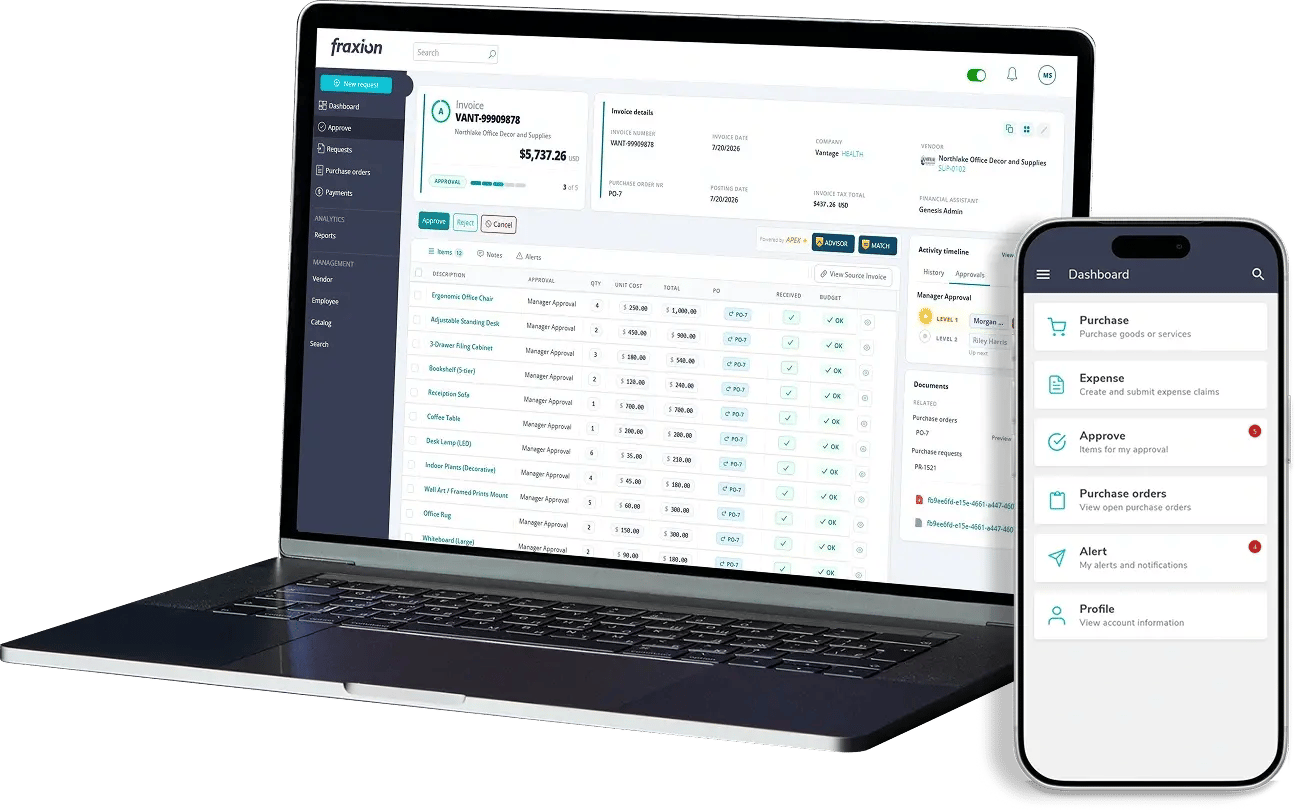
Fraxion brings together structured purchasing and expense workflows, budget validation, guided buying, AI-powered AP automation, and advanced spend analytics in a single system that connects directly with ERP and accounting platforms. It also includes a native mobile app, Microsoft Teams integration, and 50+ PunchOut catalog integrations.
Rather than replacing your ERP, Fraxion works alongside it to provide the visibility and control that many finance teams need before spending occurs.
If you are currently researching procure-to-pay platforms and want to see how these capabilities function in a real environment, you can schedule a demo of Fraxion to explore how a connected workflow can help simplify purchasing and accounts payable across your organization.