Approval workflow
Invoice approval software: How AP teams cut approval time
Learn how invoice approval works, why manual processes slow AP teams down, and what to look for when automating invoice approvals.

A PO approval workflow is the sequence that determines whether a purchase order gets authorized: who reviews it, in what order, and under what conditions it can move forward. In many systems, this happens after the fact: a PO is created first, then routed for sign-off. In a proactive spend management model, it works the other way around: the purchase request is what gets reviewed and approved, and the PO is generated automatically once that approval is complete. The PO isn't a document waiting for a signature; it's the output of a decision that's already been made. Automating this workflow replaces manual handoffs with structured routing, so requests reach the right approver based on amount, department, category, or budget without any delays along the way.
A manual PO approval process often looks something like this: a purchase request or PO is printed or emailed, and left waiting for a signature or response. Once signed off, it's passed to the next approver, and the wait begins again. These manual handoffs can create delays, limited visibility into where a PO actually sits, and consume administrative time that would otherwise go toward higher-value work.
Automating approval at the request stage, before a purchase order is ever generated, addresses these shortcomings directly. This guide covers what a PO approval workflow entails, why manual sign-off tends to break down, how the request gets approved, and the PO created automatically, and what to look for when evaluating a solution.
To get a purchase order approved, best practice is to ensure that a requisition is raised using an approved vendor and assigned to the appropriate budget, so it can be reviewed and approved by the right manager. That review and approval process is the PO approval workflow.
Some systems approve the purchase order only after it has already been created, but approving the requisition first is the stronger model, because it establishes control at the point of decision, rather than validating a purchase that has, in effect, already been committed via a formal purchase order process.
In Fraxion's approval workflow automation model, all approvals and controls take place before the PO exists, so there's no separate sign-off stage once the purchase order is created.
Manual PO approval tends to run into a familiar set of problems as purchasing activity grows:
Lost or delayed paperwork. A physical PO can sit on a desk or get misplaced entirely.
Approvals sitting in email inboxes. Digital doesn't automatically mean faster if a request is just waiting for someone to notice it.
Limited visibility into approval status. Requesters and finance teams often can't easily tell whether a PO is pending, approved, or stalled.
Delays when an approver is unavailable. If the one person who needs to sign off is out of office, the PO simply waits.
Repeated administrative follow-up. Someone has to chase the approval down, which takes time away from other work.
Difficulty reconstructing who approved what. Piecing together an approval history from email threads or paper trails after the fact is time-consuming.
Lack of a clear audit trail. Without a structured system, documenting the full approval history for compliance or reporting purposes becomes harder.
These issues aren't specific to any one organization. They're a natural consequence of managing PO sign-off with informal tools and processes as volume and complexity increase.
An automated approval workflow generally follows a consistent sequence:
A purchase request is submitted.
The request is routed to the appropriate approver. Depending on how the organization's rules are configured, routing may take into account factors such as spend amount, department, category, or approval threshold.
The approver is notified.
The approver reviews the request and approves, rejects, or flags it according to the organization's process.
Additional approval occurs where required, for example, when a request exceeds a certain threshold or involves more than one approver.
Once the required approvals are complete, the PO is generated automatically, or a user can initiate it, depending on how the organization's rules are configured.
Once generated, the PO can be emailed to the vendor automatically or sent manually by a user, using the organization's branded PO templates.
Not every organization configures these rules the same way, and not every platform offers identical routing options. The value of automation lies in applying the rules an organization has defined consistently, rather than relying on someone to manually decide who sees a PO next.
Automating the steps to PO approval tends to deliver a few practical benefits:
Faster movement from request to PO, since approvals happen upfront and the PO is generated once they're complete, with no separate document waiting to be actioned
Less manual administration, with fewer follow-ups needed to chase down an approval or signature
Better visibility into approval status for requesters, approvers, and finance teams, before a PO ever exists
More consistent routing, applying the same rules from requisition to PO rather than relying on individual judgment, case by case
A clearer audit trail, with the approval decision documented as part of the request itself and carried through to the PO it generates
It's one thing to describe these benefits in theory. It’s another to see how they translate into measurable results for a real organization. See how aTyr Pharma automated purchase order approvals with Fraxion and turned a manual process into a faster, more efficient workflow.
When evaluating PO approval software, it's worth checking for the following:
Automatic approval routing – requests reach the correct approver without manual handoffs
Mobile approval capability – the ability to review and approve a request from a mobile device
Approval status visibility – a clear view of where a request and PO sit at any given time
Multi-level approval workflows – support for more than one approver where thresholds require it
Budget and policy controls – checks against available and committed budget and procurement policy
Proxy or backup-approver or escalation functionality, where supported – keeping the requisition-to-PO process moving when an approver is unavailable
Mobile PO visibility – the ability to check a PO's status or details from a mobile device once it has been generated
A full audit trail – a documented record of the approval history, carried through to the PO it generates
This list reflects general buyer criteria for the category rather than a description of any one platform. Not every solution offers every capability, so it's worth confirming what's actually included before choosing a system.
Fraxion is an all-in-one procure-to-pay solution built for mid-market companies, and the PO approval process is one part of that broader platform.
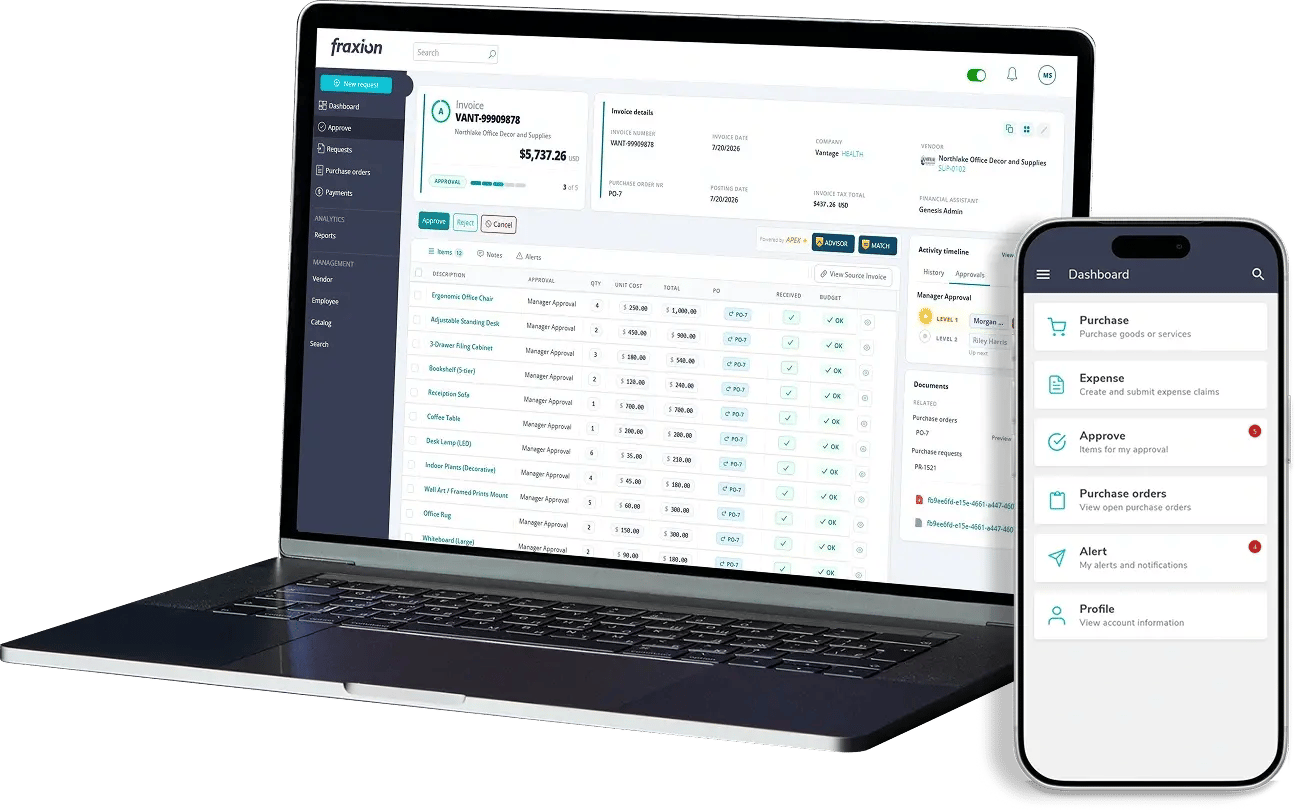
Fraxion supports PO approval through purchase order management and approval workflow automation, giving teams a structured way to route purchase requests to the right approver as part of procurement automation. Because approval happens at the request stage, the PO is generated automatically or user initiated, only once that approval is complete. Budget & policy controls are in place, and mobile procurement allows approvers to review and act on purchase requests, and view POs through Fraxion's native mobile app. As with the rest of the platform, every transaction produces a full audit trail from requisition through payment.
PO approval doesn't need to be adopted as a standalone tool. Finance teams can start with the solution they need most, procurement or AP automation, and expand to full procure-to-pay without reimplementation. You can learn more on Fraxion's purchase orders feature page.
What is a PO approval workflow?
A PO approval workflow is the process by which a purchase request is reviewed and approved before a purchase order is created, including who reviews it, in what order, and under what conditions it escalates or moves forward. In some systems, the PO itself is created first and approved afterward; the stronger approach approves the request upfront, so the PO is only generated once approval is complete.
How many approval levels should a mid-market company have? There's no universal answer. The appropriate number of approval levels depends on factors such as the organization's approval rules, spend thresholds, structure, and purchasing requirements. Some organizations need a single approver, while others require multiple levels for larger transactions.
Can PO approval routing be customized by department or spend threshold? Many PO approval systems allow routing rules to be configured around factors such as department or spend threshold, though the specific options available vary by platform. It's worth confirming what a given solution supports before assuming a particular configuration is available.
What happens when a PO approver is unavailable? This depends on how an organization's workflow is set up. Common approaches include escalation to a backup / proxy approver or routing to the next available person in the approval chain, where the underlying system supports it.
How quickly can a team set up a PO approval workflow? Setup time depends on factors such as the organization's approval rules, process complexity, and existing system environment, so there's no single timeframe that applies to every implementation.
Automating the PO approval workflow addresses the friction that comes with manual, after-the-fact sign-off: fewer manual handoffs, faster movement from requisition to approval and purchase order generation, improved visibility, more consistent routing, less administrative follow-up, and a clear audit trail.
For a broader look at how PO approval fits into the full procurement approval process, see the complete guide to procurement approval software. Or, to see what automated PO approval looks like for a real organization, read how aTyr Pharma automated its purchase order approvals with Fraxion.
Learn how invoice approval works, why manual processes slow AP teams down, and what to look for when automating invoice approvals.
Learn what procurement approval software does, how the approval process works, and what to look for when automating purchase sign-off.
Compare Fraxion, Procurify, Coupa, Tradogram, and SAP Ariba on mobile procurement, real-time budget visibility, approval workflows, and industry fit.
Get our latest content, updates, and how-to resources delivered to your inbox.
Book a demo to see how Fraxion can assist your organization.
Book a demo