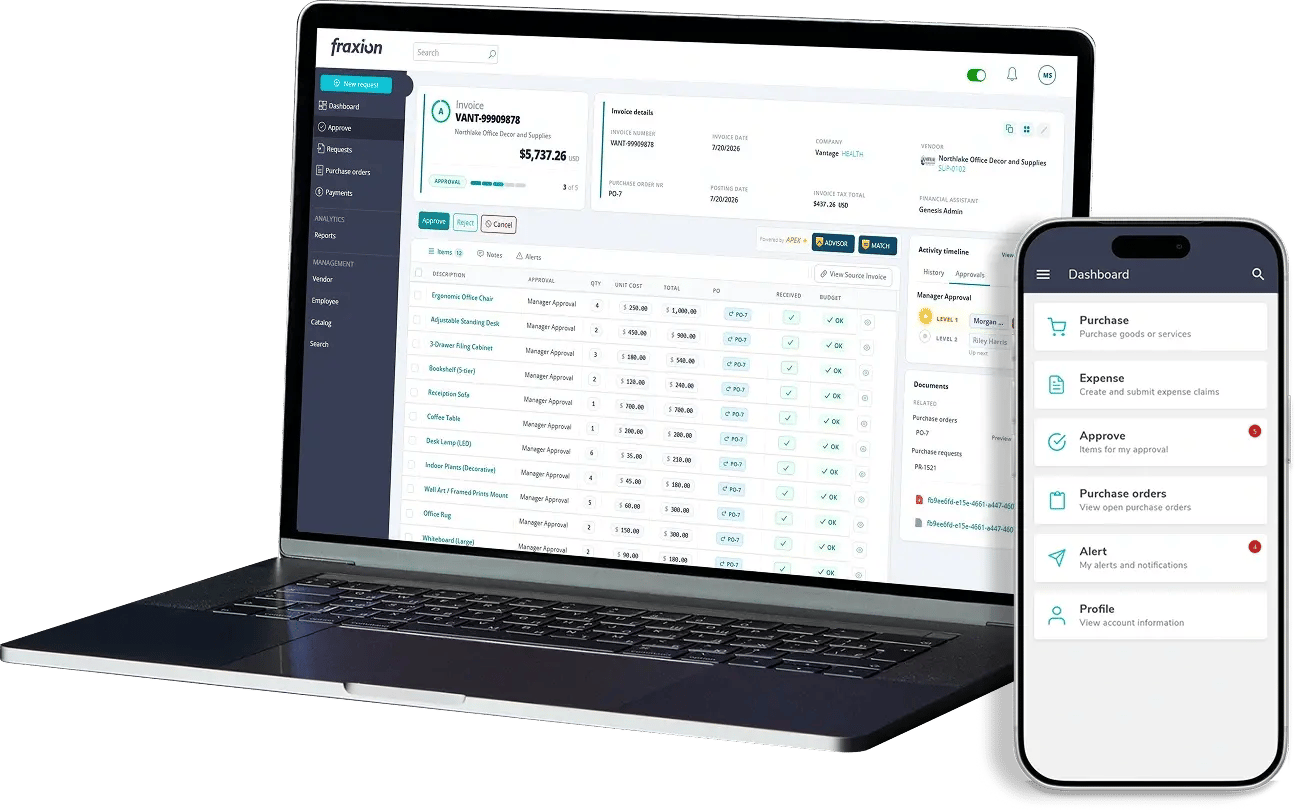
How great purchasing managers shape business outcomes
Great purchasing managers do more than control costs. They shape how an organization spends, and by extension how profitable it is, since every supplier relationship, purchase order, and approval they oversee feeds directly into budgets, working capital, and accountability. The challenge most of them face is maintaining that control without becoming the bottleneck that slows the business down, since the same organizations that need disciplined purchasing also need decisions to move at the pace operations actually requires.
This guide collects five practices that distinguish purchasing managers who consistently produce strong outcomes from those who spend most of their time on administrative work. The practices range from how vendor relationships are built and reviewed to how purchasing workflows are structured for both speed and control, and the teams that apply them consistently report meaningful improvements across three dimensions in particular: cost discipline, vendor leverage, and the share of staff time spent on strategic rather than administrative work.
1. Keep supplier performance and pricing under review
Supplier relationships drift over time. Prices creep up, service levels slip, and better options appear in the market while the team that should be re-evaluating them is too busy processing orders to do it, which is how a vendor who once represented good value ends up costing 10 to 15% more than alternatives by year two or three.
What to do: Set a structured cadence for vendor reviews, quarterly at minimum. Evaluate not just cost but total value, meaning reliability, delivery times, and compliance with your internal purchasing policies, since the most expensive vendor is often the one whose late deliveries cost you twice in operational disruption.
The impact: Teams that conduct quarterly vendor reviews report 5 to 8% cost reduction through renegotiation and consolidation, 2 to 3 additional negotiation points captured (payment terms, delivery schedules, volume commitments), and meaningfully better visibility into which vendors are actually performing.
How to implement:
- List all active vendors by spend, largest first
- Schedule quarterly reviews and treat them as non-negotiable
- Compare current pricing against alternatives in the market
- Evaluate performance on reliability, delivery, and service
- Enter performance data into your system so it informs future purchasing decisions
The tool advantage: Modern procurement platforms with embedded spend analytics centralize supplier spend and transaction data, giving you the visibility to identify pricing trends and consolidation opportunities. With fewer, better vendors, your team gains stronger negotiating power and less administrative overhead.
2. Turn vendor relationships into strategic advantages
Most vendor relationships are transactional in the sense that you send a PO, they fulfill it, you pay them, and the relationship never grows beyond that exchange. The cost of that transactional posture is usually invisible until a supply constraint reveals which vendors will prioritize you and which will not, by which point the relationships that would have helped you are with the people you spent the least time on.
What to do: Communicate early and often with your strategic vendors. Share forecasts and strategic direction. Outline clear service expectations, honor payment terms consistently, and schedule regular check-ins with the vendors who matter most to your operations.
The impact: Teams that build true vendor partnerships report higher priority during supply constraints, since your orders get fulfilled when others do not; earlier access to new products or technology from your vendors; better pricing and terms that vendors extend to trusted partners; and faster resolution of issues when problems arise.
How to implement:
- Identify your top 5 to 10 strategic vendors, by spend and by importance to operations
- Schedule quarterly business reviews with each
- Share your business goals and seasonal or cyclical needs
- Ask what challenges they face, since they often have solutions you have not considered
- Honor your payment terms, since consistency builds trust faster than any negotiation tactic
A pattern worth noting: Manufacturing teams that share demand forecasts with key suppliers three months ahead consistently report better pricing, priority stock access, and early warning when supplier costs are about to rise, which lets them adjust plans rather than absorb surprises after the fact.
3. Collaborate with your team to fast-track processes
Approvals get stuck in email. Finance does not know what operations is planning to buy. Department leads submit requests that violate policy. Everyone is frustrated, and the underlying problem is not any individual's effort but the absence of a shared workspace where intent, budget, and approval can be visible to everyone who needs to see them.
What to do: Use collaboration tools built for procurement. Every request, comment, and approval should happen in one place where all stakeholders can see status in real time, since the alternative is a fragmented record of decisions that finance reconstructs at month-end from email.
The impact: Teams using centralized procurement collaboration report:
- 40% faster approval cycles, since approvers are notified instantly rather than discovering requests in their inbox
- Fewer approval rejections, since policy requirements surface upfront rather than after submission
- Better cross-functional alignment, since everyone knows what everyone else is planning
- Higher employee satisfaction, with less frustration and faster answers
How to implement:
- Choose a procurement platform that supports real-time collaboration
- Configure approval workflows so every step is visible
- Set up notifications so approvers know when action is needed rather than relying on inbox monitoring
- Document your policies clearly in the system
- Train teams on the new workflow, since adoption is what produces the benefits
The tool advantage: Platforms like Fraxion integrate with Microsoft Teams, which means approvals happen in the tools your team already uses every day rather than in a separate system that requires a context switch. That single change removes a meaningful source of friction and speeds decision-making across the workflow.
4. Promote and empower your top performers to keep them engaged
Your best procurement staff are drowning in administrative work, approving requisitions in email, tracking down receipts, answering "where is my PO?" requests, and the cost of letting them stay there is not just productivity but turnover, since the people most capable of doing strategic work are the ones most likely to leave when the work is not there to do.
What to do: Give your team access to tools that eliminate the repetitive work, then let them spend the recovered time on analysis and strategy.
The impact: Teams with modern procurement platforms report:
- Higher retention of top talent, particularly among younger staff who expect better tools
- More strategic work, since less time on administrative tasks means more time on vendor management, cost analysis, and contract optimization
- Better decision-making, with data at their fingertips rather than hidden in spreadsheets
- Faster career growth, since team members develop stronger skills when they are not stuck on admin
How to implement:
- Automate approvals and invoice processing first, since those are the most repetitive tasks
- Give your team real-time dashboards showing spend by vendor, department, and category
- Let them generate reports and analysis without manual spreadsheet work
- Recognize team members who embrace better processes and demonstrate measurable improvement
- Promote from within when possible, since it reinforces that efficiency and accountability are valued
A pattern worth noting: Procurement teams that move from email-based approvals to automated workflows commonly report freeing up around 15% of their time, which is the equivalent of adding several staff members of capacity without hiring anyone, and almost all of that recovered time gets spent on vendor negotiations and cost optimization rather than disappearing into other administrative work.
5. Modernize your procurement stack for total visibility
Most purchasing managers run on a stack that grew without ever being designed: spreadsheets here, approvals in email, reports in the ERP, supplier data in yet another system, and none of it talking to anything else. The cost is not just the time spent reconciling systems, which is significant, but the strategic work that does not happen because the data needed to do it is too scattered to assemble.
What to do: Integrate your procurement software directly with your financial system. Make sure budgets, suppliers, and transactions stay in sync, since the value of integration is what it removes from your team's workload as much as what it adds.
The impact: Teams with integrated procurement systems report:
- Real-time budget visibility, with exact knowledge of how much is committed and how much is available
- Faster month-end close, since manual reconciliation drops to near zero
- Better compliance, with policy violations caught before money leaves the account
- Strategic insights, since spend patterns become legible enough to act on
How to implement:
- Map your approval hierarchies and spending authorities into your system
- Connect your procurement software to your ERP so purchase data flows automatically
- Set spending limits by role and department, with the system enforcing them rather than relying on memory
- Create automated alerts for budget overages, policy violations, and unusual spend
- Use dashboards to monitor spend in real time rather than reconstruct it monthly
A pattern worth noting: Mid-market services companies that implement integrated procurement software commonly report eliminating their month-end reconciliation work entirely, which on its own typically saves 2 to 3 days of finance staff time per month, with the larger benefit being that budget overages and policy violations now surface in time to act on them rather than at the end of a closed period.
The bigger picture: from execution to strategy
These five practices share a common direction, which is the shift from reactive manual procurement to proactive structured procurement, and the purchasing managers who excel at their work are usually not the ones doing the highest volume of approvals but the ones who have built systems that let the work happen faster, with better control and less friction.
When the practices are applied together, procurement starts to look less like a cost center and more like a strategic function. The team has more time for vendor relationships, cost optimization, and the analytical work that finds savings competitors miss, and the organization spends with more discipline in ways that show up directly on the bottom line.
Enable your team with the right tools
These practices are possible with manual systems, but they are substantially easier with software built for procurement. The right platform centralizes spending so policy is enforced at intake, accelerates approvals through workflow automation and real-time visibility, gives your team dashboards and analytics in place of spreadsheets, builds accountability through audit trails and reporting, and strengthens vendor relationships through the data-driven insights that come from clean transaction history.
Used well, technology in procurement is not overhead but a force multiplier, removing the friction that prevents your team from doing the work that actually moves outcomes.
Ready to excel at your purchasing role?
See how other purchasing teams are applying these five practices to improve control, reduce costs, and free up time for the strategic work that earns purchasing managers a seat at the table.
Book a demo → to see how your team could operate with better visibility, faster approvals, and measurably stronger outcomes.
Frequently asked questions
What is the biggest challenge for purchasing managers today?
The biggest challenge is maintaining control and visibility across decentralized teams. As organizations grow, manual approvals and spreadsheet-based tracking cannot keep pace, and the gap between what finance needs to see and what the systems can show widens. An integrated procure-to-pay solution helps managers enforce policy, gain real-time insights, and make faster decisions backed by data, with teams typically reporting that moving from manual to automated systems cuts approval time roughly in half while improving compliance.
How can purchasing managers improve vendor relationships?
Purchasing managers improve vendor relationships by building transparency and consistency into every transaction. Set a regular meeting cadence, quarterly is ideal, share your business goals and seasonal needs openly, honor payment terms consistently, and use data to back up your negotiations by showing vendors exactly what you are buying from competitors and what you are paying. When vendors see that you are organized and data-driven, the relationship shifts from transactional to strategic, which is where most of the value lives.
Why should finance leaders invest in procurement software?
Finance leaders should invest in procurement software because it brings proactive control to spend. Rather than catching errors after payment, a proper solution ensures every request, purchase, and invoice is approved, budget-compliant, and audit-ready before it happens. The measurable result is typically 5 to 10% cost reduction, better accountability, and stronger financial governance, and most companies recover the software investment in savings within the first year.
What makes procurement software valuable if we already have an ERP?
ERPs are strong at accounting, but their procurement modules are usually limited. They track transactions; they do not manage the processes behind them. Purpose-built procure-to-pay software fills that gap by enforcing approval rules, centralizing requests, and linking every purchase to its funding source, which is the difference between gaining control before the spend happens and reconciling it afterward. Integration with your ERP keeps data flowing cleanly, with your procurement system feeding accurate purchase data into accounting and eliminating manual reconciliation.
How long does it take to see results from better procurement practices?
Early results come quickly. Teams typically see approval cycle time improvements within the first month, with 40% faster cycles common. Cost savings emerge within three to six months as vendor consolidation and compliance enforcement take hold. Strategic benefits, including better vendor relationships, stronger cost control, and more time for analysis, continue to grow as the team gets more comfortable with the process, and the practices themselves compound over time when applied consistently.