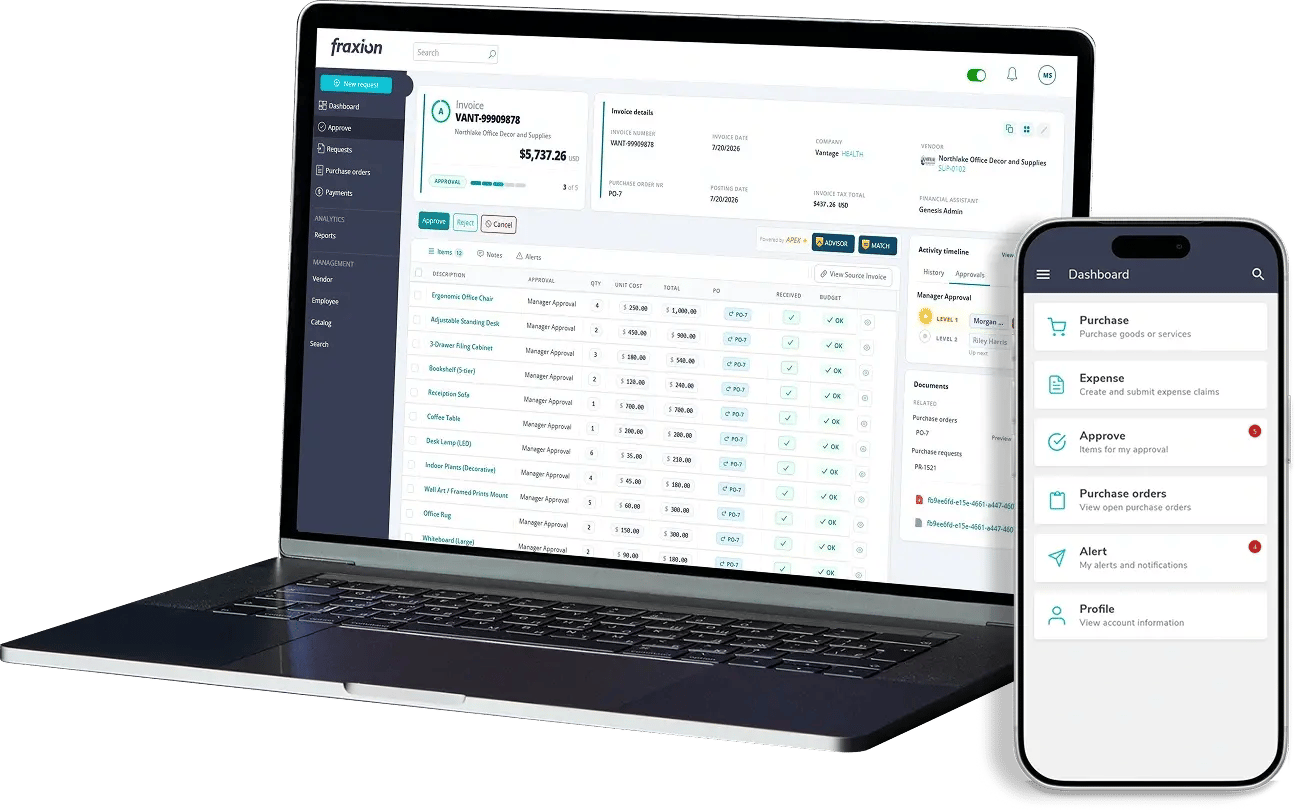
Manual purchase order approval tends to slow down for a simple reason: it depends on a document physically reaching the right person at the right time. Purchase order automation software removes that dependency, routing a PO through approval digitally instead of by hand. This article looks at what that change actually involves, using aTyr Pharma's experience with Fraxion as a real-world example of what automating the approval workflow can look like in practice.
What is purchase order automation?
Purchase order automation software handles the steps a purchase requisition goes through before a purchase order is created: routing it to the right approver, notifying that approver, and capturing the approval decision. Once the requisition is approved, a PO can be automatically created and released to the vendor according to the rules an organization has set up.
It's distinct from simply creating a purchase order in a digital format. A purchase order can be typed up in a document or spreadsheet and still require someone to manually decide who reviews it next, physically or over email. Automation addresses that routing and approval layer, allowing a purchase requisition to move forward automatically once submitted and, when approved, become a purchase order without the need for manual PO creation.
Why manual purchase order approval creates delays
Manual PO approval tends to slow down for structural reasons that have little to do with how busy any one approver is:
-
Paper forms and physical handoffs. A document has to physically move from person to person, which introduces delay by default.
-
Dependence on specific approvers being available. If the one person who needs to sign off is out of office, the request simply waits.
-
Manual follow-up. Someone has to notice a request is stalled and chase it down, which takes time away from other work.
-
Limited visibility into approval status. Requesters and finance teams often can't tell whether a PO is pending, approved, or stalled somewhere in the process.
-
Friction for remote or distributed staff. A process built around physically walking a document to a desk doesn't work well when approvers or requesters aren't in the same location.
-
Email requests and approval delays. Requests can get buried in inboxes, approvals depend on people responding, and follow-ups can create delays before a purchase can move forward.
aTyr Pharma's experience is a useful illustration of this. Its purchase order process required a form to be filled out by hand, walked to a manager for a signature, and then walked to procurement, with no guarantee it would be processed the same day. Because each stage depended on a specific person being physically available, the process could stall at any point along the way.
How automated PO approval changes the workflow
The shift from manual to automated PO approval is structural. Instead of a purchase requisition moving from person to person for approval, a digital requisition moves through a defined set of routing rules. The requisition must be submitted and approved before a purchase order can be generated.
Before automation: Purchase requisition created → physical or email handoff → manager approval → PO created manually → processing.
After automation: Purchase requisition submitted → automated routing → approver notified → requisition approved → purchase order automatically generated → PO automatically emailed to vendor.
The exact steps in the process depend on how a company configures its own rules, whether based on spend amount, department, or other factors. Every purchase requisition follows the required approval process, ensuring the appropriate person reviews and signs off on the request.
Once approved, the next steps can also be automated based on those rules. A purchase order can be generated automatically and, where required, emailed directly to the supplier. Alternatively, these steps can be initiated by a user.
The automation doesn't remove control or approval. It removes the manual work around the process: chasing approvals, forwarding requests, creating purchase orders, and keeping track of who approved what and when.
What purchase order automation software should actually do
When evaluating purchase order automation software, it's worth looking past the general promise of "automation" and checking for specific capabilities:
-
Digital purchase requisitions and PO entry, so requests don't rely on paper or free-form email.
-
Automated PO creation, generating purchase orders in seconds from approved purchase requisitions.
-
Customizable PO templates, allowing businesses to use their own templates and generate vendor-ready PDFs.
-
Automated PO emails, sending purchase orders directly to vendors once the relevant requests have been approved.
-
Mobile PO visibility, allowing users to view, download, and send purchase orders from any device.
-
Change orders and approvals, allowing PO revisions to be submitted and approved while maintaining a complete audit trail.
-
PO matching, matching purchase orders against goods received and invoices to help maintain control throughout the purchasing process.
-
Configurable approval rules, ensuring purchase requisitions are routed to the appropriate approvers based on factors such as spend amount, department, or other organizational requirements.
-
Approval status visibility, so users and finance teams can see where a requisition or PO stands in the process.
-
An audit trail, documenting approval activity and providing a record of who approved a request and when.
Not every platform offers every capability in the same way, so it's worth confirming what a given solution actually supports before assuming a particular feature is included.
The aTyr Pharma example: From physical handoffs to digital routing
aTyr Pharma, a biotherapeutics company, moved from that paper-based process described above to a digital one built on Fraxion. Purchase requests are now entered directly into Fraxion, including from remote locations, rather than filled out by hand. Once submitted, a request flows automatically through the approval process, with built-in email notifications replacing the need for someone to manually track down an approver or walk a form to their desk.
That's the specific change worth focusing on: not a general description of aTyr's operations, but the concrete shift from a physical document handoff to a request moving through an automated routing process.
The result: One to two minutes
The documented result of that shift is direct: purchase orders that once took hours now take one to two minutes to complete, even from remote locations.
That result matters less as a headline number and more as a demonstration of what removing manual handoffs actually does to a workflow. The approval requirement itself didn't disappear. What disappeared was the time spent physically moving documents, sending and following up on emails, and waiting for someone to receive, review, or act on a request. Whether a document is sitting on someone's desk or an approval request is buried in an inbox, these handoffs introduce delays that can slow the entire process down.
What the aTyr case shows about purchase order automation
A few practical takeaways follow from aTyr's documented experience:
-
Removing physical handoffs can eliminate waiting between approval stages. Most of the delay in a manual process isn't the decision itself, it's the time spent getting a document to the person who makes it.
-
Automated routing reduces approval delays and dependence on manual follow-up. A request is routed to the right approver, so it doesn't rely on someone remembering to chase it, forward an email, or move a document along.
-
Digital workflows make approval status easier to track. Because the process happens inside one system, it's possible to see where a request stands rather than reconstructing its history later.
-
Remote access matters when purchasing isn't handled from one central office. A process that requires physical presence doesn't scale well once approvers or requesters are working from different locations.
These lessons are illustrated by aTyr's experience and demonstrate what can be achieved, although results will vary by organization. The scale of improvement depends on how manual the starting process was and how an organization configures its own approval rules and levels of automation.
How Fraxion supports purchase order automation
Fraxion supports this kind of workflow through purchase order management and approval workflow automation, with mobile procurement supporting requests submitted from remote locations. Automated approval routing and an audit trail are part of how the process runs from requisition through to purchase order release. This sits within Fraxion's broader procure-to-pay platform or available as a standalone procurement solution.
For more on the mechanics of building this kind of process, learn more about automating your PO approval workflow.
Conclusion
Purchase order automation isn't just about putting a paper form into a digital format. It's about changing how a request moves from creation to approval, removing the email threads, physical handoffs and follow-ups that create most of the delay in manual and paper-based processes. aTyr Pharma's shift from hours to one to two minutes per purchase order is a concrete example of what that change can look like when approval routing and PO generation, not just the paperwork, become automated.
To see how invoice approval fits into the next stage of this process, explore invoice approval software.