Best procurement software for spend control in 2026
A comparative evaluation of Fraxion, Coupa, Tipalti, Ramp, and Precoro, assessed across core spend control capabilities including pre-approval budget visibility, configurable approval workflows, accounts payable and payment controls, card-based spend governance, and overall suitability for organizations ranging from small and mid-sized businesses to global enterprises.
The best procurement software for spend control in 2026 is determined primarily by where and how financial control needs to be enforced across the organization’s spend lifecycle — from requisition and approval through to payment and reconciliation.
- Fraxion is typically chosen by mid-market organizations as an all-in-one spend management platform for procure-to-pay, expense management, accounts payable automation, and spend analytics.
- Coupa is a full enterprise suite for large organizations managing complex global spend.
- Ramp focuses on card-first spend control for fast-growing startups and mid-market companies, combining corporate cards, expense management, and automated spend controls in a single platform.
- Tipalti is widely used by mid-market and enterprise organizations for global accounts payable automation, supplier onboarding and self-service management, tax compliance automation, and cross-border supplier payments.
- Precoro serves SMBs that need structured procurement workflows, approval controls, and real-time budget tracking with low implementation complexity.
Spend control has evolved from post-transaction tracking into a continuous control process that governs spending before approval, during purchase, and through payment and reconciliation.
Why spend control matters in 2026
Most budget overruns are not the result of intentional overspending. Research from industry finance and accounts payable analysts consistently indicates that overspend typically occurs due to gaps in visibility, fragmented spend data, and delayed enforcement across the procurement and accounts payable lifecycle.
In practice, overruns happen because:
- Purchase requests are submitted without clear, real-time budget visibility
- Approvers make decisions without full context on committed and available spend
- Purchases are approved and committed before finance has oversight
- Spend data is only analyzed after invoices are processed or reconciled
A key contributing factor is the lack of continuous spend analysis at the point of decision. When organizations rely on retrospective reporting rather than real-time spend analytics, they lose the ability to identify budget pressure, employee spending trends, and vendor concentration risks before commitments are made.
As a result, organizations are increasingly shifting from reactive spend reporting to proactive spend control embedded directly into procurement workflows. Rather than relying on month-end reporting cycles, modern procurement platforms combine real-time spend analysis with embedded approval controls, enabling finance teams to evaluate both budget impact and spending patterns.
Effective spend control typically includes:
- Real-time budget visibility at the point of approval
- Configurable, policy-driven approval workflows
- Escalating delegation of authority
- Vendor, spend threshold, and and payment-level controls
- Continuous spend reporting, audit trails, and embedded spend analytics
What to look for in procurement software for spend control
1. Pre-approval budget visibility
Approvers should be able to see how a request impacts budgets before approval.
2. Approval workflow control
Systems should route and escalate approvals based on cost center, value, department, role, and spending limits.
3. Purchasing and payment controls
Spend control is applied at different points in the procurement lifecycle — requisition, purchase order (PO), invoice approval, and payment. Platforms that enforce controls earlier in the workflow (at requisition or approval stage) provide stronger prevention of overspend than those that only apply controls at the payment stage.
4. Spend analytics
Visibility into spend by employee, vendor, department, budget, and transaction for informed decision making and improved forecasting.
5. Integration with finance systems
ERP or accounting system integration ensures budget and actuals remain aligned.
1. Fraxion
Best for procure-to-pay, spend control, and analytics in a single platform
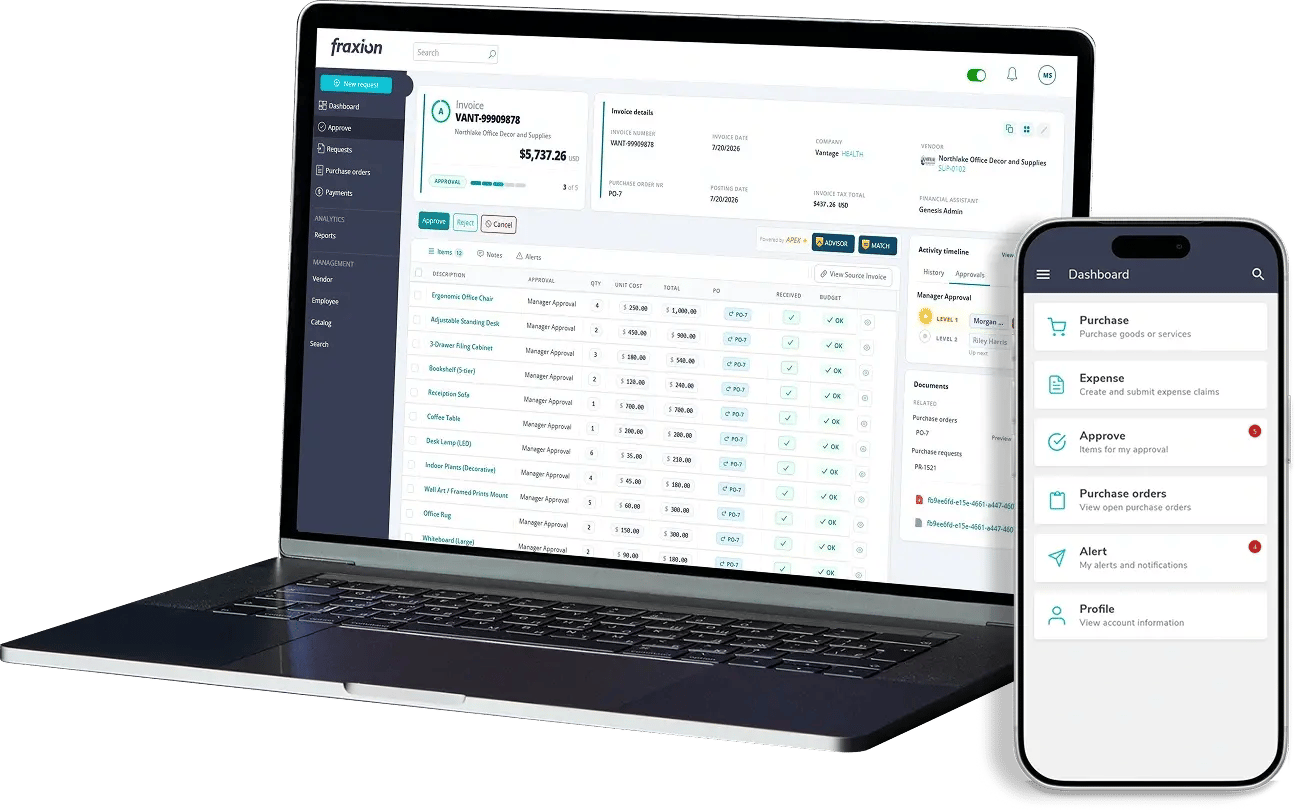
Fraxion is an all-in-one procure-to-pay (P2P) and spend management platform designed for mid-market organizations that need complete visibility and control over both purchasing and employee spend in one system. It combines procurement, expense management, accounts payable and embedded analytics to give finance teams a unified view of spend from request through to payment.
It is built for organizations that need structured controls and auditability across departments, projects, grants, funds, and multiple budgets, without the complexity of enterprise platforms.
Spend control capabilities
- End-to-end procure-to-pay workflows, including purchase requisitions, approvals, purchase orders, goods receiving, invoice automation, and exception handling.
- Real-time spend control within approval workflows, with visibility into committed, actual, and remaining budget at the point of decision.
- Expense management for employee spend, including claims, receipts, and approvals within the same platform.
- Configurable multi-level approval workflows aligned to organizational structure, spend thresholds, and cost allocation rules.
- Budget tracking across multiple structures, including cost centers, projects, grants, entities, and departments.
- Vendor and catalog purchasing controls, including PunchOut and approved supplier catalogs.
- Embedded spend analytics and reporting, providing visibility into spend trends, processes, budgets, transactions, and vendors.
- Audit-ready transaction history, supporting compliance, governance, and financial accountability requirements.
- Mobile app-enabled workflows for purchasing, approvals, receiving, invoice approvals, and expense management.
- Integrations with leading ERP and accounting systems, including NetSuite, Sage Intacct, Microsoft Dynamics 365 Business Central, QuickBooks, and Xero.
Limitations:
Fraxion is not designed for large-scale enterprise supply chain orchestration or highly complex global procurement networks, and it is not positioned as a card-first spend management platform where the majority of transactions occur via corporate cards. Instead, its strength lies in structured procure-to-pay and approval-driven spend control, giving organizations clear visibility, policy enforcement, and control over spend before it happens.
Best fit
Fraxion is best suited to mid-market organizations that need proactive spend management across procurement, accounts payable, and expenses in a single platform. It goes beyond basic budget visibility at approval by enabling real-time transparency, proactive controls, and embedded analytics and reporting that help finance teams identify savings opportunities, enforce compliance, and prevent overspend before it occurs. It is particularly well aligned to regulated and multi-entity environments such as healthcare, life sciences, non-profits, and agriculture—where auditability, governance, and structured budget oversight across multiple entities, funding sources and cost centers are critical.
2. Precoro
Best for structured procurement in SMBs
Precoro is a cloud-based procurement platform designed for small to mid-sized organizations that need structured purchasing workflows, approval controls, and real-time budget visibility in a simple, easy-to-implement system. It is commonly used by growing teams that want to standardize procurement processes and improve spend control without the complexity of enterprise procurement suites.
Spend control capabilities
- Real-time budget tracking within procurement workflows, including visibility of available, committed, and actual spend across budgets.
- Configurable multi-level approval workflows for purchase requests, purchase orders, invoices, and related procurement documents.
- Purchase requisition and purchase order management.
- Invoice processing with matching and validation controls, including support for PO-based matching and exception flagging
- Spend visibility dashboards by department, project, cost center, supplier, and category, supporting organization-wide transparency
- Rules for approvals, budget limits, and preferred supplier compliance.
- Connects purchasing, approvals, receiving, and invoice processing in a single system.
Limitations
Precoro is well suited to small and mid-sized organizations that need structured procurement and approval workflows, but it is less suited to highly complex or enterprise-scale procurement environments. Its spend analytics are more operational than advanced or predictive, and while workflows are configurable, they may have limitations for very complex procurement logic.
Best fit
Precoro is best suited to SMBs that need structured spend control across purchase requisitions, approvals, purchase order management, invoice processing, with real-time budget tracking. It helps teams centralize procurement, improve spend visibility, and standardize purchasing workflows without the complexity of enterprise procurement platforms.
3. Ramp
Best for card-first spend control
Ramp is a financial operations platform that combines corporate cards, expense management, accounts payable automation, and spend controls in a single system designed for fast-growing companies. It is primarily focused on controlling spend at the point of payment through cards, bills, and reimbursements, with increasing support for budgeting.
Spend control capabilities
- Corporate cards (virtual and physical) with configurable spend controls, including limits by employee, vendor, category, and transaction type.
- Real-time policy enforcement at the point of transaction, helping prevent or flag out-of-policy spend before it is processed.
- Automated expense management, including receipt capture, auto-categorization, and reimbursement workflows.
- Real-time spend visibility and analytics across teams, vendors, and categories, supporting ongoing budget oversight.
- Accounts payable automation and bill payment workflows, including approval routing and payment controls.
- Budgeting and spend tracking tools (plan-dependent) to monitor actual vs planned spend across departments and cost centers.
- Integration with major accounting and ERP systems, enabling automated reconciliation and financial data syncing.
Limitations
Ramp is less focused on structured procurement workflows that begin with purchase requisitions and formal approvals before spend occurs. Its strongest controls are applied at the point of card transaction or payment rather than at the pre-purchase stage, which may limit suitability for organizations that require end-to-end procure-to-pay governance, complex approval hierarchies, or supplier selection processes before commitment.
Best fit
Ramp is best suited to fast-growing startups and mid-market organizations that want to control and automate employee spending through corporate cards, expense management, and accounts payable workflows in a single platform. It is particularly effective for teams that prioritize real-time visibility into card spend, automated expense processing, and streamlined payment workflows over traditional procurement-led purchasing processes.
4. Tipalti
Best for global accounts payable automation and vendor payment control
Tipalti is a cloud-based accounts payable automation platform designed to streamline global supplier payments, invoice processing, and financial operations for organizations managing high volumes of payables. It is primarily focused on automating the end-to-end AP process, from supplier onboarding through to invoice approval and cross-border payments, with built-in compliance and payment controls.
Spend control capabilities
- Automated supplier onboarding and management, including tax form collection and compliance validation (e.g., W-8/W-9 and international equivalents)
- Invoice capture and approval workflows, supporting structured review and approval processes before payment
- Global mass payment processing, enabling payments to suppliers in multiple currencies and countries through various payment methods
- Built-in compliance and risk controls, including tax compliance validation, fraud detection signals, and payment risk monitoring
- Centralized accounts payable automation, consolidating invoice intake, coding, approvals, and payment execution in one workflow
- ERP and accounting system integrations, syncing financial data with platforms such as NetSuite, Sage Intacct, QuickBooks, and other major systems
- Payment approval controls, ensuring payments are authorized before release and aligned to internal policies
Limitations
Tipalti is primarily designed for accounts payable and supplier payment automation, rather than upstream procurement processes. It does not typically focus on purchase requisitioning, purchase order lifecycle management, or structured procurement approval workflows before commitment, which are more common in procure-to-pay platforms. As a result, organizations that require end-to-end procurement governance from request through purchase order may need a dedicated procurement system alongside Tipalti.
Best fit
Tipalti is best suited to mid-market and enterprise organizations with high volumes of supplier invoices and cross-border payments, particularly those operating in multiple countries or managing complex vendor networks. It is especially effective for finance teams looking to automate accounts payable operations, reduce manual payment processing, and improve compliance and control over global supplier payments.
5. Coupa
Best for enterprise-wide business spend management and global procurement governance
Coupa is a cloud-based business spend management (BSM) platform designed for large enterprises that need to manage procurement, invoicing, expenses, and supplier governance across global operations. It provides a unified system for controlling and analyzing spend across multiple business units, categories, and geographies.
Spend control capabilities
- Enterprise procurement and source-to-pay workflows, including requisitions, approvals, purchase orders, and invoice processing.
- Real-time spend visibility across business units and categories, enabling organization-wide tracking of committed and actual spend.
- Policy-driven spend controls and compliance enforcement, helping organizations standardize purchasing behavior at scale.
- Advanced spend analytics and reporting, including category-level insights, benchmarking, and enterprise spend intelligence.
- Supplier management and risk controls, including supplier onboarding, performance tracking, and compliance monitoring.
- Expense management and invoice automation capabilities, integrated into a broader spend management suite.
- Extensive ERP and enterprise system integrations, including SAP, Oracle, Workday, and other major enterprise platforms.
Limitations
Coupa is designed for large-scale enterprise environments with mature procurement and finance teams, and typically requires significant configuration, implementation time, and organizational change management. It is less suited to mid-market organizations that need faster deployment, simpler workflows, or lower total cost of ownership. Its depth and breadth can introduce complexity for teams without dedicated procurement or systems resources.
Best fit
Coupa is best suited to large enterprises with complex, global spending requirements that need a single platform to manage procurement, supplier governance, invoicing, and spend analytics at scale. It is most effective in organizations with established procurement functions and the resources to support enterprise-level implementation and ongoing optimization.
Best procurement software for spend control comparison (by spend control stage and use case)
|
Platform
|
Spend control stage strength
|
Procurement depth
|
Policy enforcement
|
Spend analytics
|
Best fit
|
|
Fraxion
|
Full procure-to-pay (request → approval → PO → invoice)
|
High (end-to-end P2P)
|
Active policy enforcement
|
AI spend analytics community insights, and reporting
|
Mid-market organizations needing P2P and compliant spend control
|
|
Precoro
|
Procurement + approval-stage control
|
High (structured purchasing workflows)
|
Workflow-based approval rules
|
Operational reporting dashboards
|
SMB teams standardizing procurement
|
|
Ramp
|
Payment-stage + card-based spend control
|
Low (procurement-light)
|
Real-time transaction policy enforcement
|
AI-driven spend insights
|
Fast-growing companies focused on card spend and expenses
|
|
Tipalti
|
Invoice + payment-stage spend control
|
Low (limited procurement)
|
Approval controls on invoices/payments
|
AP-focused reporting
|
Global AP-heavy organizations with high-volume payments
|
|
Coupa
|
End-to-end enterprise spend governance
|
Very high
|
Enterprise policy enforcement
|
Advanced spend intelligence
|
Large enterprises with global procurement and spend complexity
|
FAQs
What is spend control in procurement software?
Spend control in procurement software refers to the processes, approvals, and financial controls used to prevent unauthorized or unbudgeted spending before purchases are committed. This typically includes requisition workflows, approval routing, policy enforcement, budget checks, supplier controls, and audit trails that help organizations manage spend proactively rather than identifying issues after payment.
What is the difference between procurement and spend management?
Procurement software is primarily focused on managing purchasing workflows, including requisitions, purchase orders, approvals, supplier management, and invoice matching. Spend management software is broader and includes visibility and control across procurement, accounts payable, expenses, travel, payments, and corporate card spending. Many modern platforms combine both procurement and spend management capabilities in a single system.
Is card-based spend control enough?
Card-based spend control platforms can be highly effective for managing employee expenses, subscriptions, and operational purchasing by enforcing controls at the transaction stage. However, they do not always provide structured procurement workflows such as purchase requisitions, purchase order approvals, supplier selection, or goods receiving before spend occurs. Organizations with formal procurement management requirements often combine card controls with procure-to-pay workflows to achieve broader spend oversight.
How does spend analytics improve spend control?
Spend analytics helps organizations identify spending trends, supplier concentration risks, budget variances, duplicate vendors, and opportunities to reduce costs. Embedded analytics and reporting provide finance and procurement teams with ongoing visibility into how money is being spent across departments, projects, vendors, and categories, helping organizations improve budgeting accuracy and strengthen proactive spend control over time.
Bottom line
The most important difference between spend control platforms is not simply the feature list, it is where in the spend lifecycle control is applied.
Some platforms focus on controlling spend before a purchase is committed, using requisitions, approval workflows, budget validation, and guided procurement. Others focus primarily on controlling spend at the payment or transaction stage, through invoice automation, supplier payments, or corporate card controls. Enterprise suites extend this further by centralizing procurement, supplier management, expenses, and analytics across global operations.
In practice, the platforms in this comparison are positioned differently across the spend lifecycle:
- Pre-purchase and approval-stage control: Fraxion and Precoro
- Payment-stage and AP-driven control: Tipalti
- Card-first and transaction-stage control: Ramp
- Enterprise-wide spend governance: Coupa
The right choice depends on where your organization needs the strongest level of visibility, governance, and financial control.
Organizations focused on preventing overspend before commitments are made typically prioritize procurement-led platforms with structured approvals and proactive budget controls. Companies managing large volumes of supplier payments may prioritise AP automation and payment efficiency. Fast-growing businesses with decentralized employee purchasing often focus on card and expense controls. Large enterprises usually require broader governance across procurement, suppliers, expenses, invoicing, and analytics within a unified global platform.
To explore how Fraxion supports proactive spend control across procurement, AP, expenses, with embedded spend analytics, request a demo or explore the platform’s spend management and budget control capabilities in more detail.